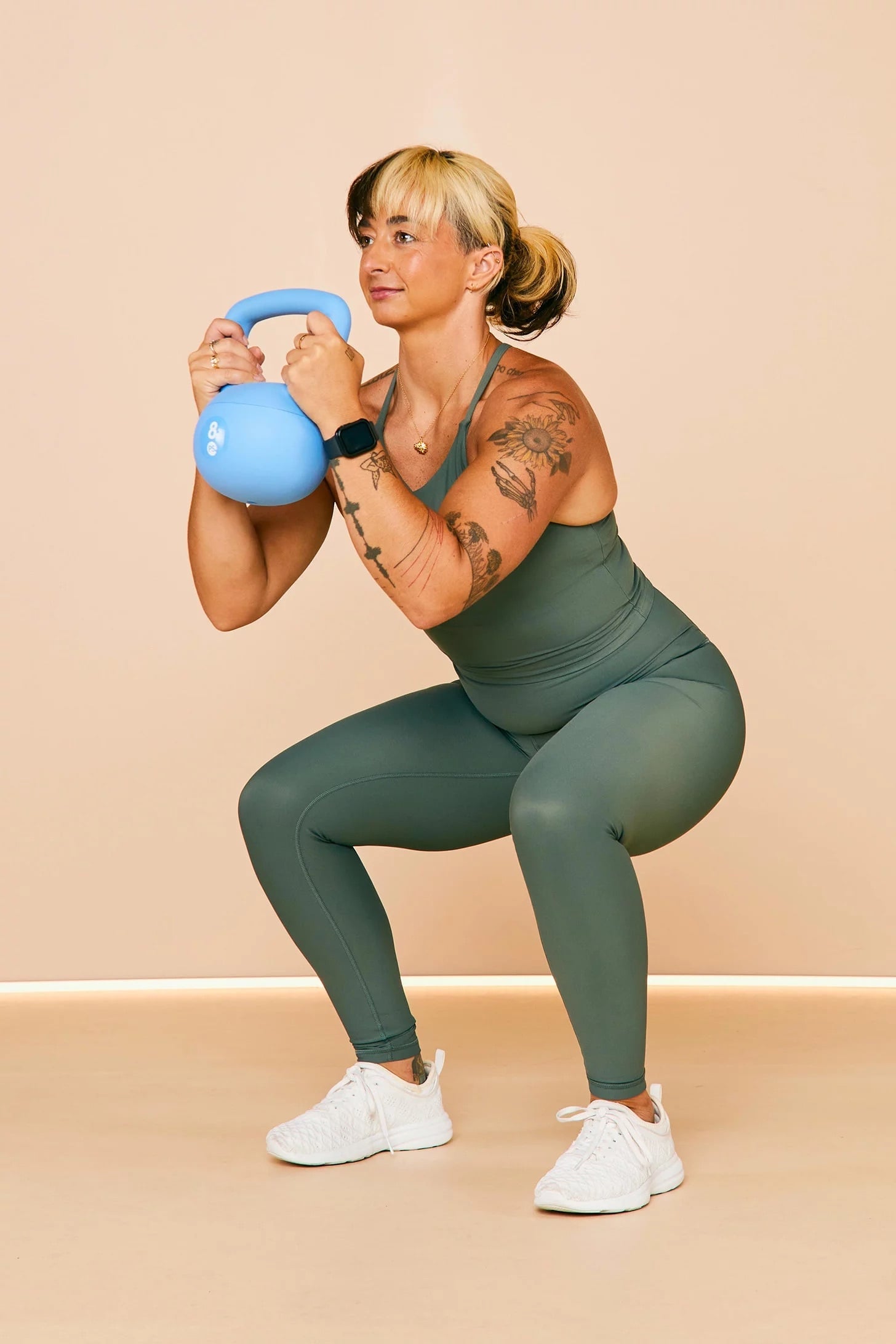
If you're looking to strengthen your lower body, squats are one of the most effective exercises you can do. As a compound exercise [1] that works several large and powerful muscle groups, squats get your heart rate up, build strength, and improve your mobility [2]. Still, just because squats look simple doesn't mean they're easy to perfect — in fact, there are plenty of ways to do them wrong.
In order to prevent injury and get the most out of your workout, it's important to learn how to do squats with proper form. Doing them with improper form can add unnecessary stress to your joints, and increase your risk of strains and sprains. Not sure if you're squatting with proper form? We asked certified trainers how to squat safely and effectively. Ahead, they gave us their best tips for squatting correctly — whether you're using your own bodyweight [3], dumbbells, or barbells. They even shared some of the most common mistakes to look out for. Once you've mastered the basics, the squat variations are practically endless.
For those new to strength training or learning how to squat for the first time, bodyweight squats [4] are the perfect place to start. As you get more comfortable with your form, try out some of the weighted variations below to get even stronger. Read on to learn more about squats — from correct form, to trainer-approved squat variations.
Experts Featured in This Article
Alexis Iannucci [5] is a dancer, choreographer, and NASM certified personal trainer.
Lydia Turner [6] is a certified personal trainer and group fitness instructor.
What Do Squats Work?
Whether you do bodyweight squats or weighted squats, this lower-body exercise targets some major muscle groups. According to the National Academy of Sports Medicine [7] (NASM), squats can work your quadriceps, glutes, hamstrings, and calves. You'll also engage your transverse abdominis [8] (deep abdominal muscles), the erector spinae (the muscles along your spine), and your inner thighs.
Benefits of Squats
Squats improve lower-body strength, endurance, and power, according to NASM, all of which will help you with walking, running, cycling, dancing, hiking — and well, just about everything. Research from the Strength and Conditioning Journal [9] confirms that the squat movement pattern is "one of the most primal and critical fundamental movements necessary" for improving athletic performance, reducing injury risk, and supporting lifelong physical activity. The movement is required for essential daily activities like sitting or lifting, and it's crucial in most sporting activities too. It can improve performance skills like sprint speed and jump height, promote better balance, and reduce muscle loss in older adults, according to the International Sports Science Association [10] (ISSA). Simply put: regular squatting makes day-to-day life a lot easier (and safer).
Proper Squat Form
As fundamental as squatting is, there's a lot of debate regarding correct form. You've probably seen fitfluencers [11] arguing about whether or not to use a weight belt, elevating toes or heels, and how low you need to go before it's considered a "real" rep. To cut through the noise and make sure you're squatting with proper form, trainers say to focus on the following:
- To begin, place your feet shoulder-width apart (or slightly wider). For maximum stability, certified personal trainer Alexis Iannucci says to "keep your weight planted firmly in your feet before beginning your squat."
- From here, Iannucci says to brace your core and keep a neutral spine, sending your gaze outward to prevent your shoulders from rolling forward.
- Bend your knees and send your body back as if going to sit down in a chair. Think about keeping your chest lifted and your heels on the ground.
- Iannucci says to "keep your knees in line with your second and third toe and press through your feet equally on your way up." If your knees are frequently knocking in or out, you may need to work on strengthening some of the smaller muscles around your hips.
- As a final note, your back shouldn't excessively arch or round during any part of your squat, and your feet shouldn't roll to either side.
If you're having trouble with any of these above — or experiencing pain while squatting — it's a good idea to tap a certified exercise or medical professional for help, according to the ISSA. Another thing that can help with form: choosing the right footwear. If you feel comfortable, squatting barefoot is the best option, says certified personal trainer Lydia Turner. This way, you're able to feel all the muscles in your feet and push using your entire foot, Turner says. If you want to wear shoes (gym floors aren't always the cleanest), she suggests flat styles like Vans, Converse, or even Nike Metcons.
How Low Should You Squat?
Squat depth has a lot to do with your overall goals and mobility, as a deeper squat with a greater range of motion makes the muscles work for longer [12]. However, you should never sacrifice good form just to go deeper in your squat. NASM also says there aren't any extra quad-developing benefits to going past the point where your thighs are always parallel to the floor. That said, you should still focus on getting to that parallel point in order to reap the full benefits of your squat.
Turner says that working towards this mobility is a major area of focus for her own clients. "We work on form, maintaining that upward chest, making sure that their heels are able to stay on the ground, and [that] they're able to come all the way down to 90 degrees with their heel being on the ground," she says. "That's a big thing in itself."
Common Mistakes
Some of the mistakes trainers see most often are easily rectified with a little extra mindfulness and deep stretching.
- Lifted heels: Turner says lifted heels is one of the mistakes she sees most often. "It just means that your ankle mobility is a little tight because maybe you've been sitting down, maybe you wear high heels to work, different things like that," she explains. To loosen up and increase your mobility on the back side of your legs, hold a squat for 30 seconds and just let those heels come down, or do a calf stretch. This might also help squats feel more comfortable, since lifting your heels and pressing through your toes is a lot more quad dominant, and can create additional strain on the knees.
- Letting your chest fall forward: Ideally, your chest should always stay lifted. If you're struggling with this, it may be a sign to strengthen your lower back, Turner says. Working on back extensions can strengthen these muscles and help you keep your chest up when you squat.
- Knee misalignment: Watch your knees when you're squatting. Make sure they're not collapsing inward, which can put excessive stress on the knees and lead to injury. You can also prevent excessive strain on the knees by balancing the weight throughout your foot and heels, making sure not to lean too far forward.
How to Do a Bodyweight Squat
If you're new to squatting, bodyweight squats (also called "air squats") allow you to work your lower body while focusing on your form and mobility. Here's a primer on how to do a bodyweight squat with proper form.
- Stand with your feet shoulder-width apart or just a little bit wider, with your toes very slightly turned out. Clasp your hands at chest level.
- Engage your core [13] and bend at the knees and hips, sticking your butt backward like you're sitting in an imaginary chair. Keep your chest lifted and your spine neutral, trying not to round or arch your spine. Try to keep your weight spread throughout your whole foot, and think about grounding all 10 toes into the floor.
- Pause when your thighs are parallel to the floor, or as low as you can go with good form.
- Push into your feet and squeeze your glutes to straighten your legs and hips and return to standing. That's one rep.
- Start with three sets of 10 squats, then add more reps (12, 15, 20) as you get used to the motion. Get comfortable with your form and mobility before adding additional weight.
How to Do Squats With Weights
Additional weight will definitely add more intensity to your squats, but you should still keep basic squat form in mind. That's why you may want to stick to a single dumbbell or kettlebell. (If you're looking for recommendations, we like the PS Fit 8lb Soft-Shell Kettlebell [14] ($20).) If you're looking for an effective way to build muscle and strength, here are a few different ways to add more weight to your squats.
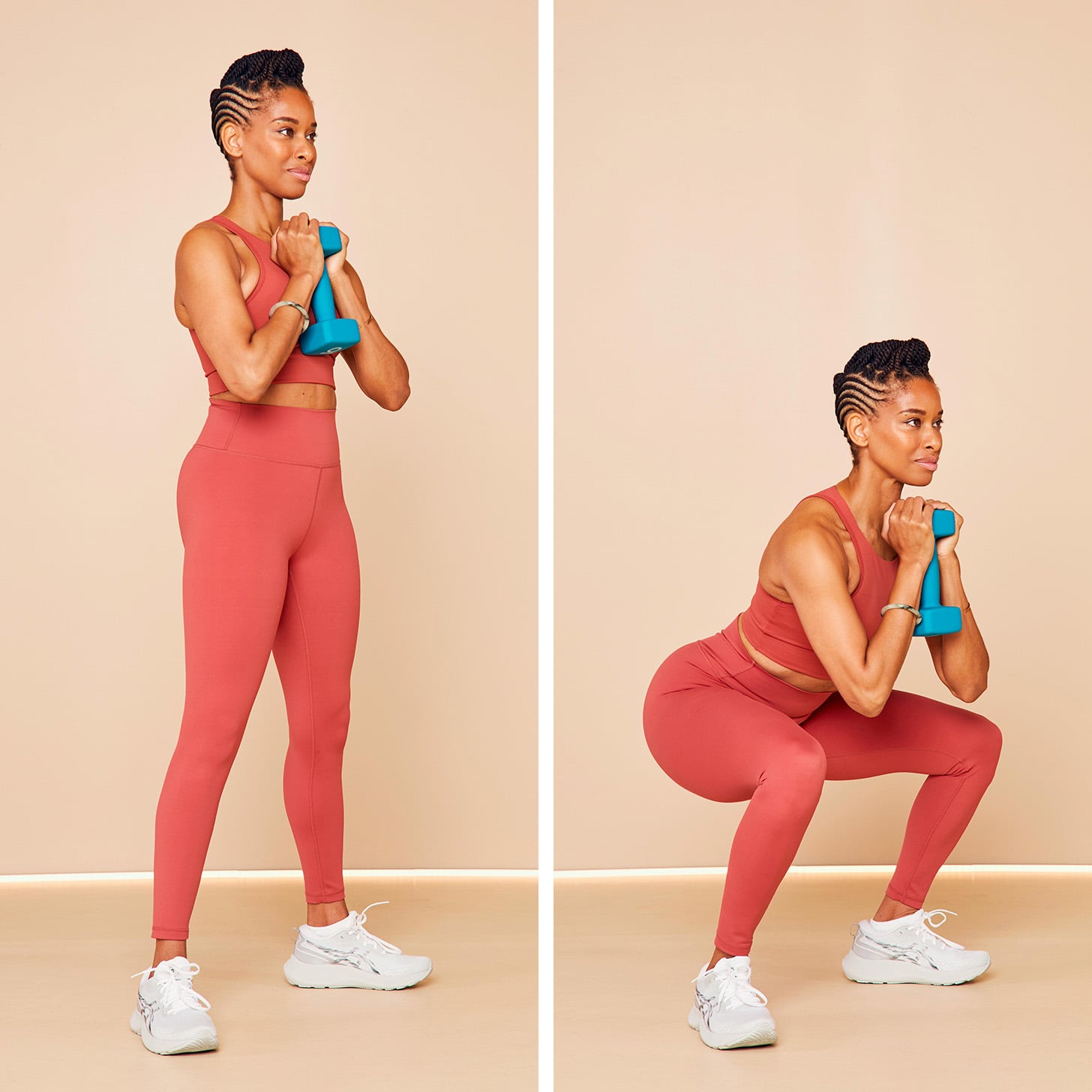
- Dumbbell Goblet Squat: Hold a single dumbbell with both hands horizontally at your chest (shown above).
- Kettlebell Goblet Squat: Hold a kettlebell with both hands at your chest.
- Shoulder-Racked Dumbbell Squat: Hold a dumbbell in each hand just above your shoulders.
- Suitcase Squat: Hold dumbbells or kettlebells by your sides.
- Overhead Squat: Hold dumbbells, kettlebells, a barbell, a medicine ball, or a weight plate above your head.
- Barbell Back Squat: Hold a barbell across your back, on top of your shoulders. "My tips for barbell squats are to just start with the bar," Turner says. "I would say [try] doing sets of maybe 15 just to get the form down and get the stability." From here, you can start adding weight in two and a half or five weight increments, making sure to use the guardrails if needed. "If you want to try a new weight, and let's say that you fail, all you do is just drop down and just let it hit the guardrails."
- The Smith Machine: Another, potentially less intimidating way to try barbell squats is the Smith Machine, which is a barbell already fixed within rails. "It's great because it doesn't move," Turner says. (As opposed to free weights and regular barbells.) "It's the easiest thing ever. All you have to do is put the barbell on your back like you're going to squat, and then just rotate the bar forward."
Squat Variations
If you've already mastered the basic bodyweight squat and want to switch things up, you might also like some of these squat variations:
- Jump squat: Do a basic bodyweight squat, but instead of standing up, explode through your feet to jump off the ground, landing softly.
- Sumo Squat: Start with your feet wider than shoulder-width, and toes turned out (shown above).
- Single-Leg Squat: Balance on one leg, and sit back to lower into a squat on your standing leg.
— Additional reporting by Jenny Sugar and Chandler Plante

Lauren Mazzo [16] was the senior fitness editor at PS. She is a certified personal trainer and fitness nutrition specialist through the American Council on Exercise. Prior to joining PS, she worked for six years as a writer and editor for Shape Magazine covering health, fitness, nutrition, mental health, sex and relationships, beauty, and astrology.
Jenny Sugar [17] is a former PS staff writer. She reports on all things fitness, but especially loves CrossFit and yoga.
Chandler Plante [18] (she/her) is an assistant health and fitness editor for PS. She has over four years of professional journalism experience, previously working as an editorial assistant for People magazine and contributing to Ladygunn, Millie, and Bustle Digital Group.