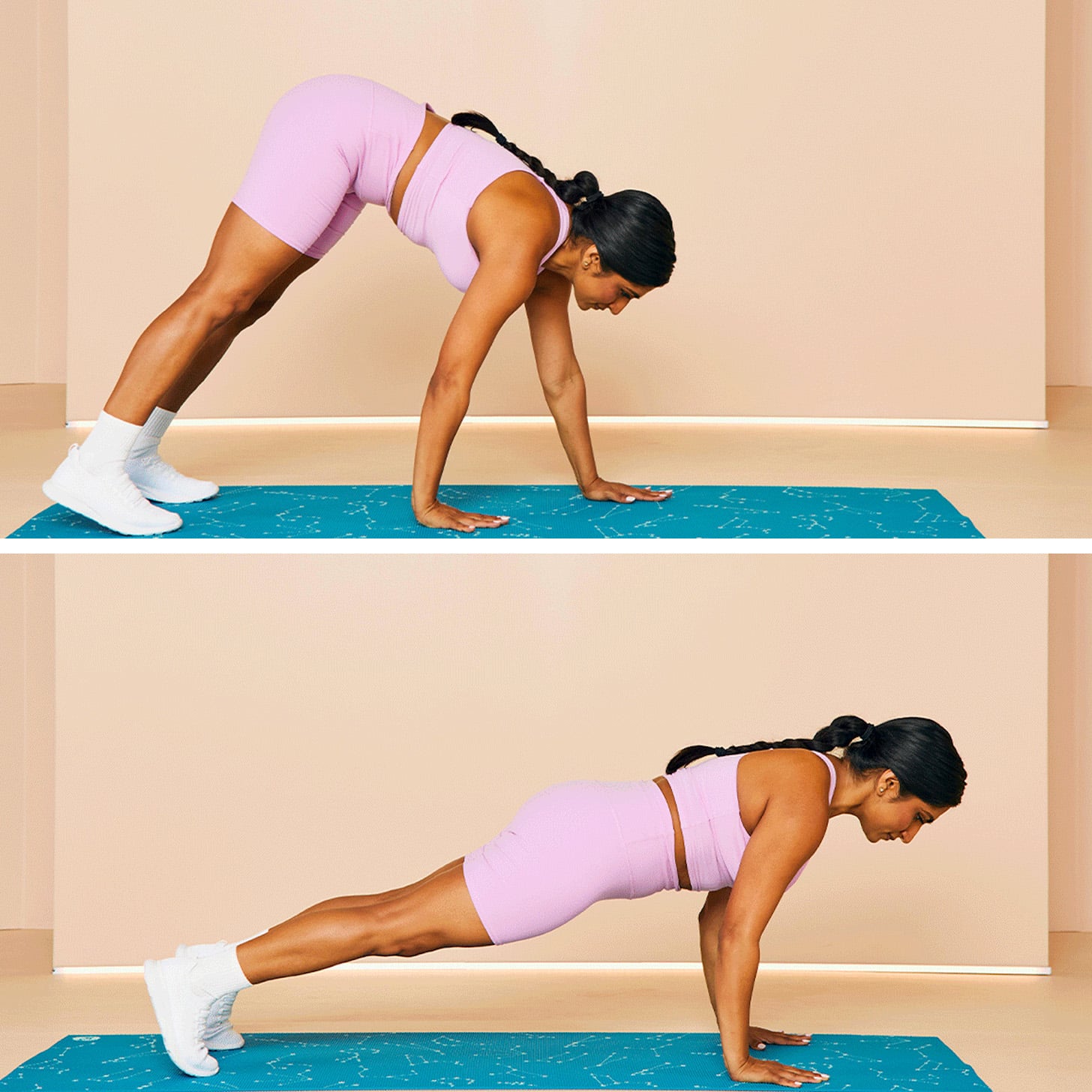
If you struggle to find the motivation (or the time) to warm up before your workouts, let us introduce you to your new best friend: the inchworm. This exercise is a perfect dynamic warmup because it recruits a variety of muscles from the upper and lower body, helps get your blood flowing and body temperature up, and mobilizes your joints to help prepare your body for movement.
The inchworm makes an appearance in many warmup routines because it's proven to work. A 2022 study in the journal Arthroscopy, Sports Medicine, and Rehabilitation [1] found that a dynamic warmup including inchworm walkouts helped prevent trail running injuries, when done as part of a prehab program. An older study from 2011, published in the Journal of Strength and Conditioning Research [2] found that a dynamic warmup that included inchworms led to greater improvements in college basketball players' lower-body explosiveness — as measured by vertical jump and long jump — than a static stretching warmup or no warmup. Dynamic stretching can also be used before a strength workout to reduce stiffness and improve range of motion without fatiguing the muscles.
If all that wasn't enough, the inchworm can be a solid strength-building move in its own right; you can even increase the intensity by adding in a push up at the end. Read on for more information about the benefits of performing inchworm walkouts, what muscles are being used, and some alternative exercises for beginners.
Inchworm: Muscles Worked and Benefits
The inchworm exercise is a total-body movement, incorporating muscles from the upper body, lower body, and core. It also helps engage both the anterior (front side of the body) and posterior (back side) chain. When starting the movement from standing, inchworm walk-outs require you to move into a hip-hinge pattern (just like when doing deadlifts [3]), which involves the hips and glutes. Next, when "walking" the arms out from the downward dog pose to the plank position, the body relies on using a combination of upper and lower body muscles. From the plank position [4], you have the option to descend down into a pushup before reversing the movement, further engaging the upper body and core.
In addition to helping warm up, activate, and bring blood flow to the muscles to prepare them for movement, the inchworm exercise helps with developing coordination and balance. You'll notice the effects not just at the gym, but also in a lot of simple movements that you do throughout the day, like reaching down to pick up groceries or wipe up a spill on the floor. The inchworm is also relatively accessible, considering that it doesn't require any equipment, and is a low-impact exercise [5].
 PS Photography | Chaunté Vaughn
How to Do an Inchworm
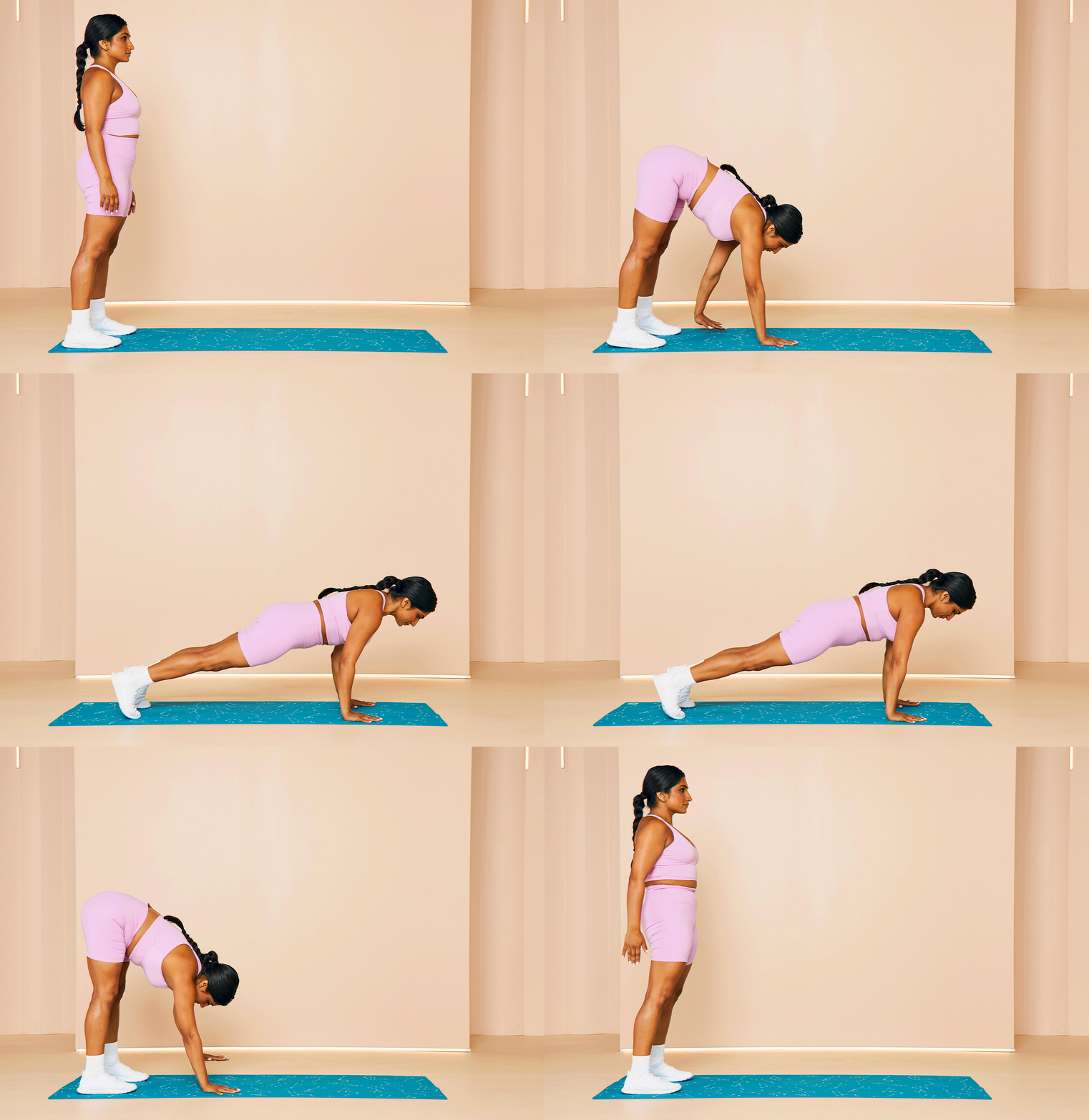
If you're a fan of yoga, you probably know how to do an inchworm already — it's essentially the same movement that's used to help people transition from downward dog to plank. Here's a step-by-step guide.
- Starting from standing, create a soft bend in the knees and push the hips back behind you, hinging at the hips into a forward fold.
- Slowly walk both hands out in front of you, passing through a downward-dog pose, until you reach a full plank position.
- Optional: For an added challenge, from the plank position complete one push up.
- From here, you have the choice of walking your feet towards your hands, trying to keep the knees as straight as possible, then returning to standing, or rewinding the motion by walking your hands back towards your feet, then returning to standing.
Inchworm Alternatives
An inchworm might look basic, but it's no joke. If the full motion is a bit too much of a challenge, there are plenty of modifications to try.
- Forearm Plank Hold: Starting with your belly on the floor or a mat, push up gently off the ground to come into a forearm plank, while keeping the hips and spine level with one another. Start by holding for five to 10 seconds for one to three sets, slowly adding on more time as you grow stronger.
- Plank Hold: To progress from a forearm plank hold, try a performing a plank hold with both arms extended and your palms on the floor. Again, start lying face-down, then push off the ground onto your hands, keeping a nice even alignment between your spine and hips. Start off for one to two sets of five to ten seconds.
- Downward Dog: Start from a prone position (meaning your stomach is on the floor) and slowly curl the toes underneath you and push away from the floor, bringing your hips towards the sky. The body will create an inverted "V" shape. Aim to have your feet fully on the floor, your knees straight but not locked. You can also slowly bend one knee at a time, pedaling out the feet, to feel a gentle stretch in the back of the calf muscles. Work on holding this position for short intervals of time, such as three to five seconds for one to three sets.
- Hip Hinges: Hone the first movement of the inchworm walk-out by practicing your hip hinge form. To do: stand about six inches in front of a wall, with your back facing the wall. With your back flat and a slight bend to your knees, bend or hinge forward at the hips and reach your butt backward until it taps the wall, and then return to standing.
Jade Esmeralda [6] (she/her), MS, CSCS, is a health and fitness staff writer and a strength and conditioning specialist. A lifelong martial artist and dancer, Jade has a strong passion for strength and conditioning, sports science, and human performance. She graduated with a Master of Science degree in exercise science and strength and conditioning from George Washington University.