As far as workouts go, planks are your bread and butter. Dependable and simple, this staple core exercise [1] is accessible for beginners, challenging for advanced exercisers, and customizable in countless ways. It's easy to be seduced by showy moves that use novel equipment or complex movement patterns, but you shouldn't sleep on planks no matter where you are in your fitness journey [2]. Really, the vast majority of people would be better off with more planks in their life.
Another word of caution is not to underestimate planks. Just because you do them frequently doesn't mean you have them mastered. Planks require you to tap into your mind-muscle connection to ensure you're keeping up the proper form, and they remain challenging, no matter how often you do them. The second you start to get lazy about your planks is the second your hips sag, your butt spikes, and you start to sacrifice any and all benefits the plank may offer — and put yourself at risk of injury to boot.
So why are planks so great, and how do you make sure you score all the benefits? This guide has everything you need to know about the plank exercise, including the benefits of planks, how to do a plank properly, and the best plank variations to choose from, depending on your needs.
Experts Featured in This Article
Robin Long, [3] a Pilates instructor and the founder of Lindywell Pilates.
The Benefits of Planks
Planks are known as a core exercise. They drill down on core stability [4], which is important for transferring energy and movement between your upper and lower body and protecting your spine.
But the benefits of planks don't stop at your abs. "Planks target the entire body, which makes them efficient and effective," says Robin Long, [5] founder of Lindywell Pilates.
If you want to know exactly which muscles we're talking about here, research in the journal Musculoskeletal Science & Practice [6] shows that planks work your rectus abdominis, obliques, transverse abdominis [7], and muscles along your spine (all part of your core). But research in the journal Physiotherapy Theory and Practice [8] also shows that planks engage your quadriceps, glutes, shoulders, chest, and upper back.
"Some of the benefits of incorporating planks consistently into your routine are improved posture, increased core strength, and decreased back pain," Long adds. Because planks are an isometric exercise [9] (read: you're holding still in one position), they're great for building up endurance of all those muscles, too. That pays off when you need to use your core for an extended period of time, whether it's to stay on your feet for a while or maintain posture while sitting at your desk.
Plank Exercise Form Tips
Planks are simple, but it's actually really easy to do them wrong. "It's important to be mindful of your alignment and positioning during planks, maintain conscious core engagement, remember to breathe, and modify when needed," Long says.
For example, "a common mistake I see in traditional planks is people dropping their hips so low that they end up with a hyperextension (or arch) in the lower back," Long explains. That puts unnecessary strain on your lumbar spine (aka your lower back), and it's also "uncomfortable and inefficient," she says. The fix? "Focus on keeping your hips in line with your spine, keeping your lower back long, and envision that you are drawing the tips of your hip bones closer together — this will help to activate deep core engagement [10] and protect your lower back," she says.
Another common mistake that shows up in both high planks and elbow planks is sinking down between the shoulder blades, Long adds. "Instead, think of pushing the ground away from you, filling the space between your shoulder blades. This will activate the muscles of the upper back to help you get more out of the exercise while also protecting your shoulders and reducing your risk of injury."
That said, it is possible to round too much into the upper back. If you're feeling the work only in your upper back and not at all in your core, make sure your upper back isn't domed upward; instead, think about opening up your chest. This will help you find the sweet spot for your shoulder blades. Research confirms [11] that the exact plank form that results in the most core muscle engagement is one in which your shoulder blades are reaching toward each other and your tailbone is slightly tucked.
It might sound like a lot to keep track of, and it is. (After all, this is a full-body exercise!) If you can't have a trainer check out your form, doing planks in front of a mirror or recording yourself on your phone can help you see whether you're in the right position.
How to Do a Plank Correctly
There are tons of different ways to do planks — and we'll get to some of those plank variations shortly — but a high plank (think: top of a push-up) is considered the "original" way to do one. Here's how to do a plank correctly.
- Start on all fours with your hands and knees on the ground. Your hands should be directly below your shoulders and knees directly below your hips.
- Extend one leg straight behind you, then the other leg, so your feet are about hip-width apart and you're balancing on your palms and toes. Your body should form a straight line from the top of your head to your heels. Keep your neck long, looking down at the floor about a foot in front of your hands.
- Hold this position, thinking about pulling your belly button in toward your spine, tucking your tailbone slightly, and maintaining a proud chest.
Plank Cautions and Modifications
If you have wrist pain during planks [12], try switching to a low plank or elbow plank. When on your palms, you should also be pressing into the floor with all five fingertips to help take the pressure off your wrist.
And while a regular plank is a simple exercise, it can still be a lot for beginners. Keep reading for plank exercise variations, including one that's easier than a regular high plank.
Like with all exercises, if you feel pain, stop doing that move. Consult a certified trainer for a form check, and consider seeing your doctor if the pain persists.
Plank Variation: Knee Plank

This is the first step in learning how to do planks for beginners. If you are struggling with regular planks, want to work on your form, or need to be careful due to injury, the knee plank is for you.
- Start on all fours with your hands and knees on the ground. Your hands should be directly below your shoulders and knees directly below your hips. Extend one leg straight behind you, then the other leg, so your feet are about hip-width apart and you're balancing on your palms and toes, then immediately lower your knees down to the floor.
- Your body should form a straight line from the top of your head to your knees. Keep your neck long, looking down at the floor about a foot in front of your hands. Tuck your tailbone slightly to make sure you're not bending at your hips, and think about pulling your belly button toward your spine.
- Hold this position for 15-60 seconds.
Plank Variation: Bear Plank
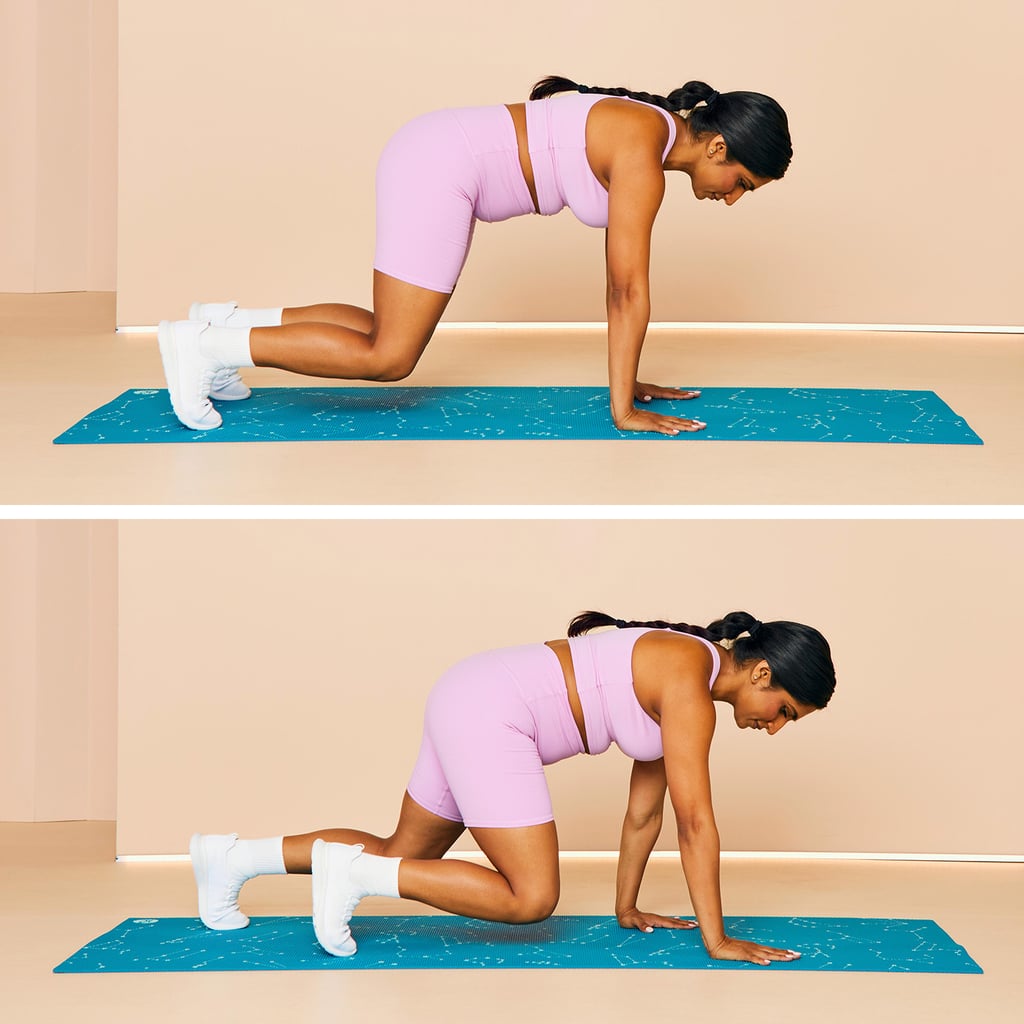
Bear planks are another great beginner plank option; for some people, it can be easier to engage your core without your legs extended. To spice it up, you can step your feet in and out of a regular plank [13], or start bear crawling [14] (as shown here).
- Start on all fours with your hands and knees on the ground. Your hands should be directly below your shoulders and knees directly below your hips.
- Tuck your toes, and engage your core to lift your knees a few inches off the floor. Keep your back straight and neck long, looking down at the floor slightly in front of your hands. Think about pulling your belly button toward your spine. If you feel your back start to arch, take a break.
- Hold this position for 15-60 seconds.
If you're interested in leveling up to a bear crawl, take a small step forward with your left foot and your right hand at the same time, then your right foot and left hand. Then reverse the move to return to the starting position. That's one rep.
Plank Variation: Elbow Plank
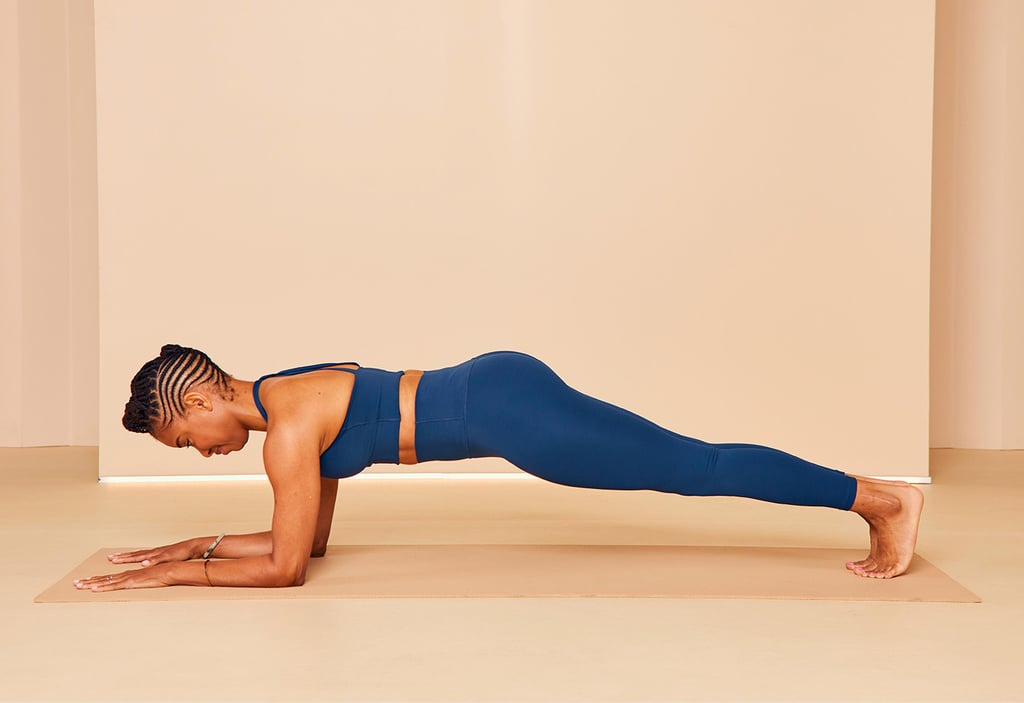
Here's how to do the other main type of plank: the elbow plank or low plank. If you're a beginner, you can do a kneeling version of this plank, too.
- Start lying face-down on the floor, with your elbows directly below your shoulders, forearms extending forward with your palms flat on the floor.
- Tuck your toes and engage your core to lift your hips off the ground, then your knees. Your body should form a straight line from the top of your head to your heels. Keep your neck long, looking down at the floor about a foot in front of your hands. Tuck your tailbone slightly, and think about pulling your belly button toward your spine.
- Hold this position for 15-60 seconds.
Plank Variation: Low Side Plank
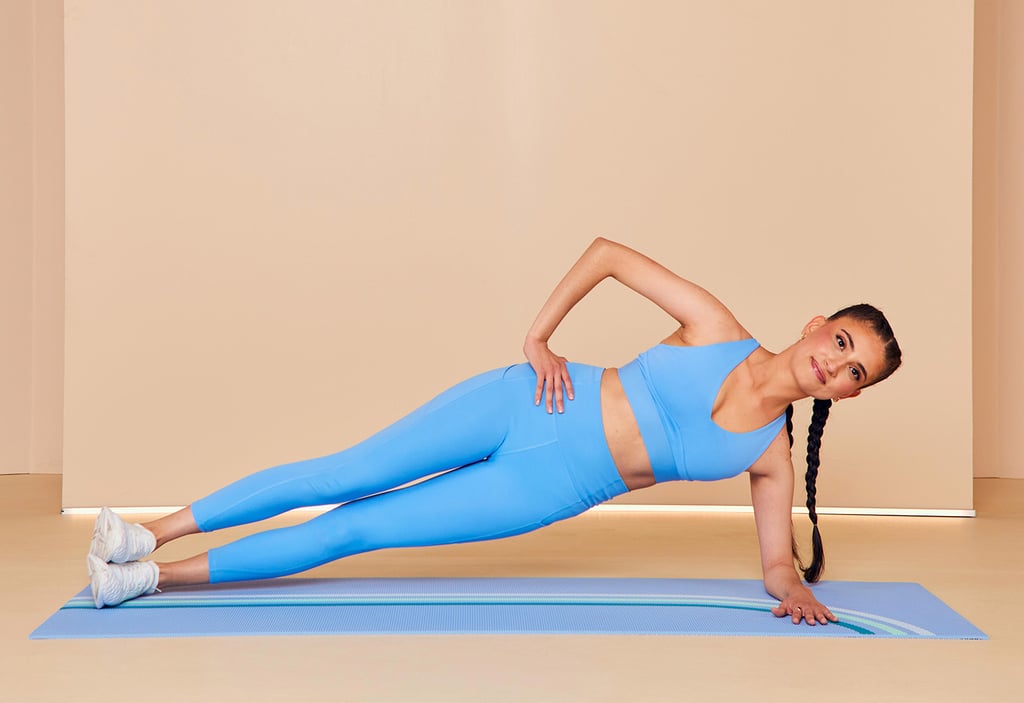
Side planks [15] can be done on your elbow or palm, though doing them on your elbow makes it much easier to balance. If needed, you can also perform side planks on your knees.
- Lie on your right side on the floor. Prop yourself up on your forearm, making sure your elbow is right below your shoulder. With your legs fully extended, stack your left foot on top of your right.
- Press into your right foot and elbow to lift your hips up into a side plank, forming a straight line from head to heels. Keep your neck long, and make sure your hips are stacked; don't allow your hips to tilt forward or backward.
- Hold this position for 15-60 seconds. Repeat on the other side.
Plank Variation: Plank Leg Lift (With or Without Rock)
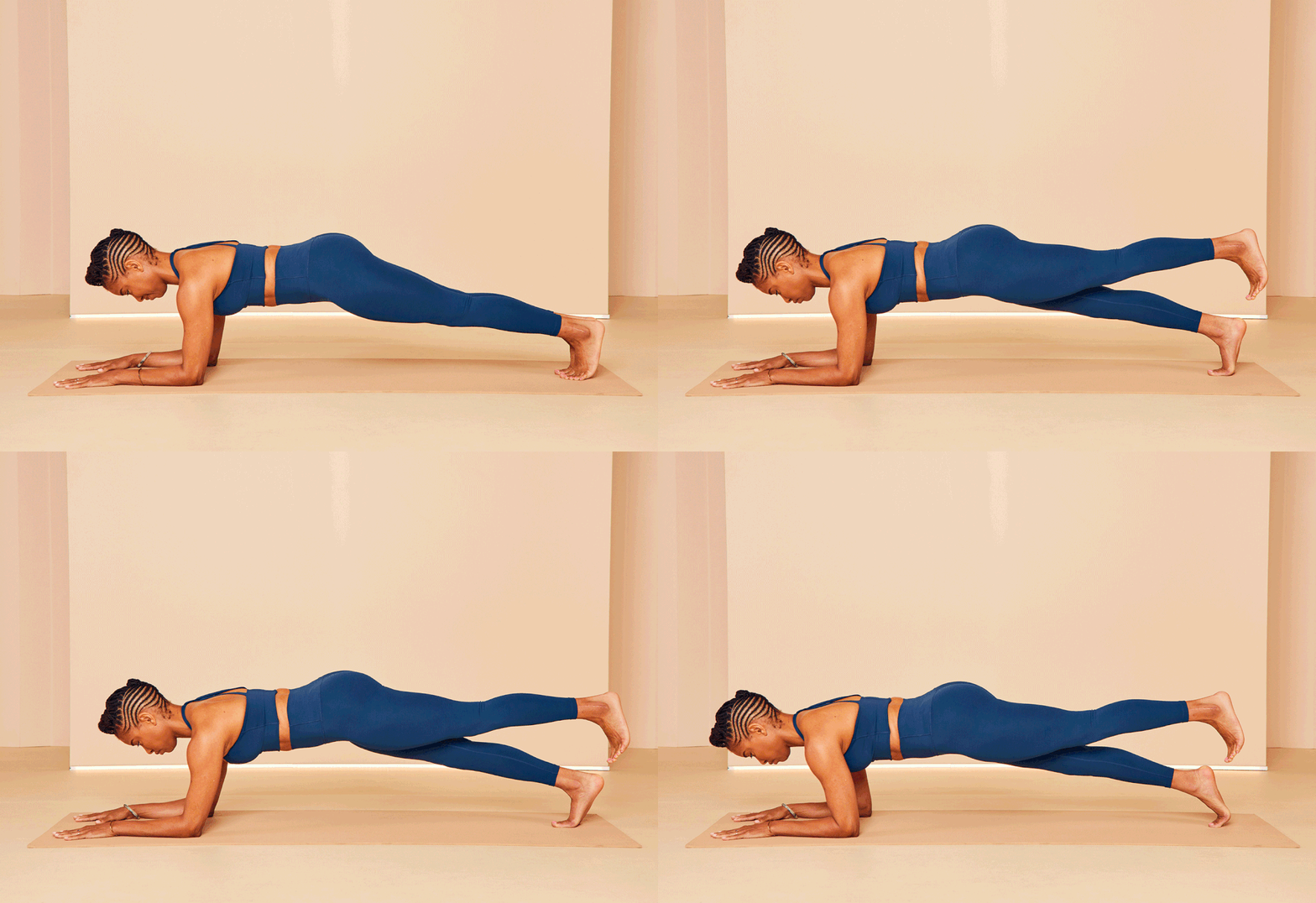
To bump up the engagement of your hamstrings and glutes, add a leg lift to your low plank, and to increase the challenge even more, add a rocking movement. During this move, be sure not to arch your back; only lift your leg as high as you can without arching.
- Start in a low plank position, elbows directly under your shoulders and palms flat on the floor. Engage your core and tuck your tailbone slightly to find a neutral spine.
- Without moving anything else in your body, lift your right foot up a few inches, squeezing your right glute. You can simply hold here for two seconds, then lower your foot. Or, holding your foot in the air, rock your body slightly back, then forward, then return to your start position and slowly lower your foot to the floor. Repeat on the opposite side.
- That's one rep. Do three sets of 10 reps, resting for 30 seconds to one minute between sets.
Plank Variation: Low Plank Saw
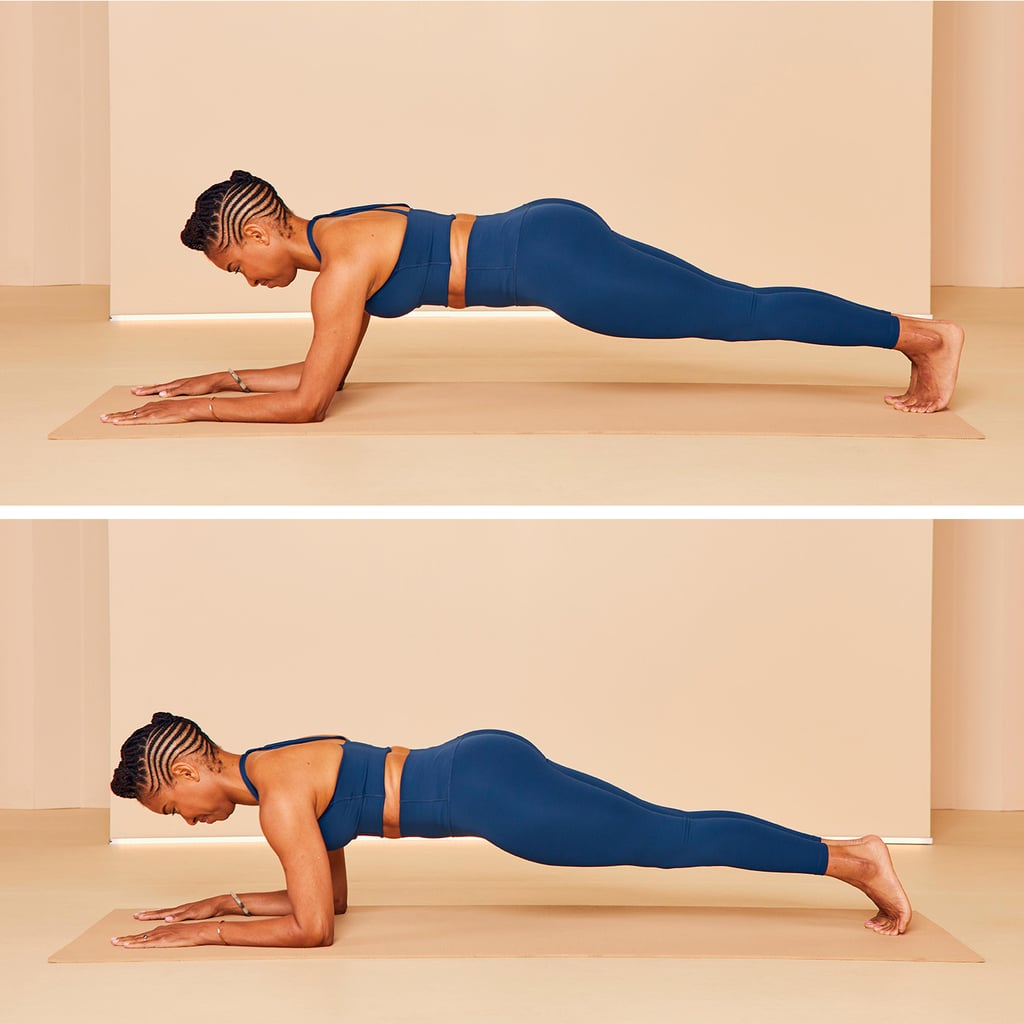
If you're not feeling challenged by regular planks, this moving plank variation should surely wake up your core.
- Start in a low plank position, but instead of pressing your palms into the floor, clasp your hands together.
- Without moving anything else in your body, slowly shift forward on your toes to slide your shoulders a few inches forward, so they're no longer above your elbows.
- Then shift backward on your toes to slide your shoulders back, so they're just behind your elbows.
- That's one rep. Do three sets of 10 reps, resting for 30 seconds to one minute between sets.
Plank Variation: Plank Shoulder Taps
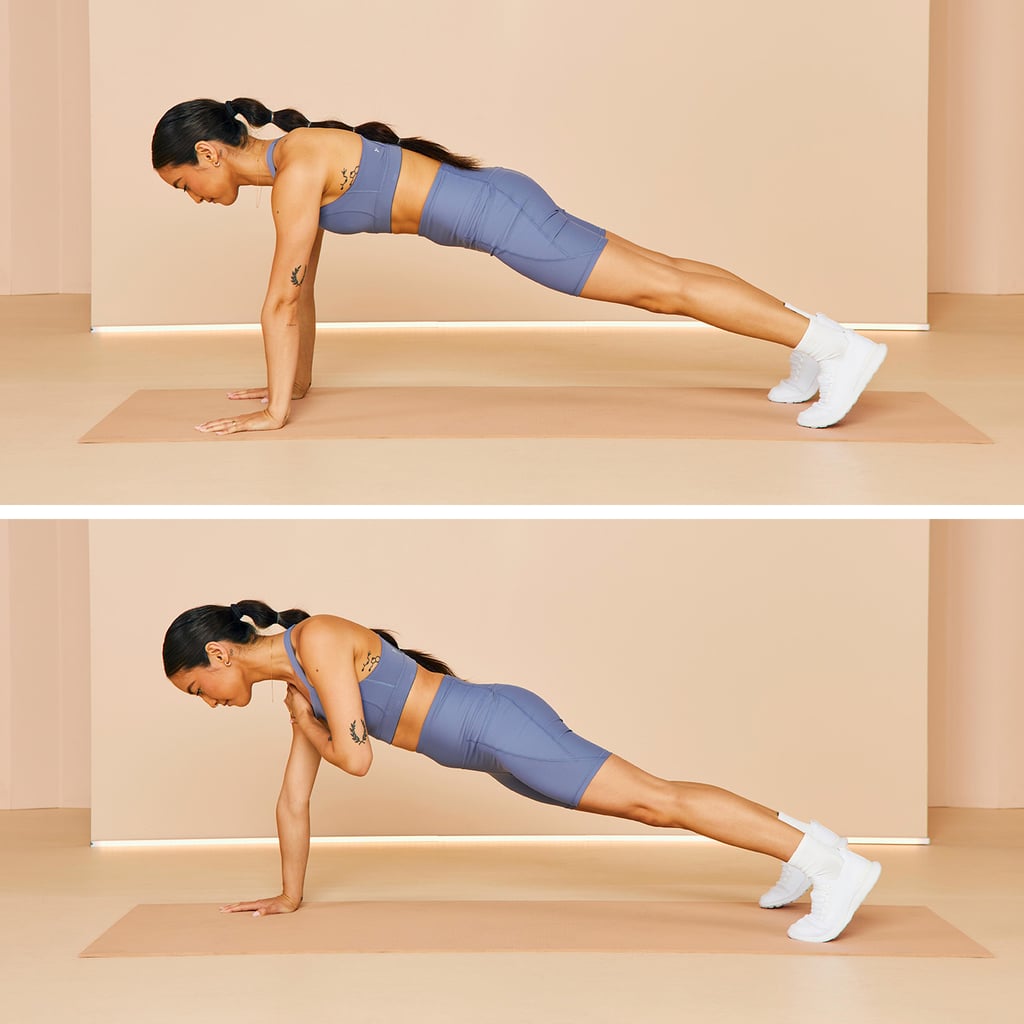
To challenge yourself in a high plank and feel a burn in your arms, add some shoulder taps.
- Start in a high plank position with your shoulders over your wrists, core engaged, and tailbone slightly tucked. Step your feet out so they're shoulder-width apart or slightly wider.
- Without moving anything else in your body, lift up your right hand to tap your left shoulder. Try not to let your hips rotate to the side, and keep your weight centered between both feet. With control, place your right hand back on the floor.
- Repeat on the opposite side, tapping your right shoulder with your left hand.
- That's one rep. Do three sets of 20 reps, resting for 30 seconds to one minute between sets.
Plank Variation: Plank Jacks

With plank jacks [16], you get the core recruitment of planks, plus the heart-pumping cardio aspect of jumping jacks. If jumping is too much, you can also step your feet in and out.
- Start in a plank position with your shoulders over your wrists, core engaged, and feet together.
- Like the motion of a jumping jack, jump your feet out wide and then back together. Try to keep your pelvis steady, and don't let your hips rise toward the ceiling or dip toward the floor.
- That's one rep. Do three sets of 20 reps, resting for 30 seconds to one minute between sets.
Plank Variation: Renegade Row
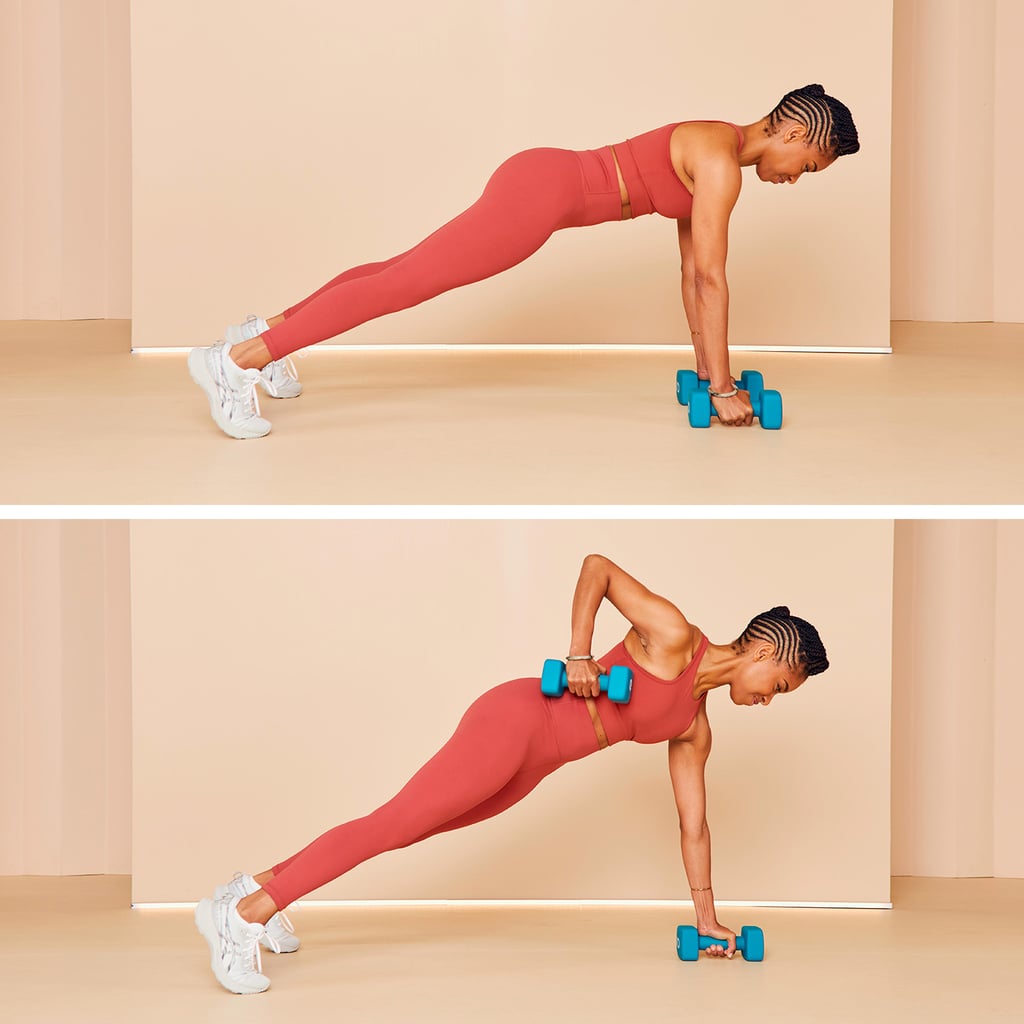
Boost the upper-body activation of your planks by turning them into a renegade row. With two light- to medium-weight dumbbells, you can work your upper back as well as hit your core with a balance challenge.
- Start in high plank, each hand holding a dumbbell that's resting on the floor. Step your feet out so they are shoulder-width apart or slightly wider.
- Pull your right elbow back, lifting the dumbbell toward your ribs, keeping your right elbow close to your torso. Make sure you're not rotating or shifting your hips; keep your weight centered in both feet.
- Lower the weight to the floor to return to plank, then repeat on the opposite side.
- That's one rep. Do three sets of 10 reps, resting for 30 seconds to one minute between sets.
Plank Variation: Up-Down Plank
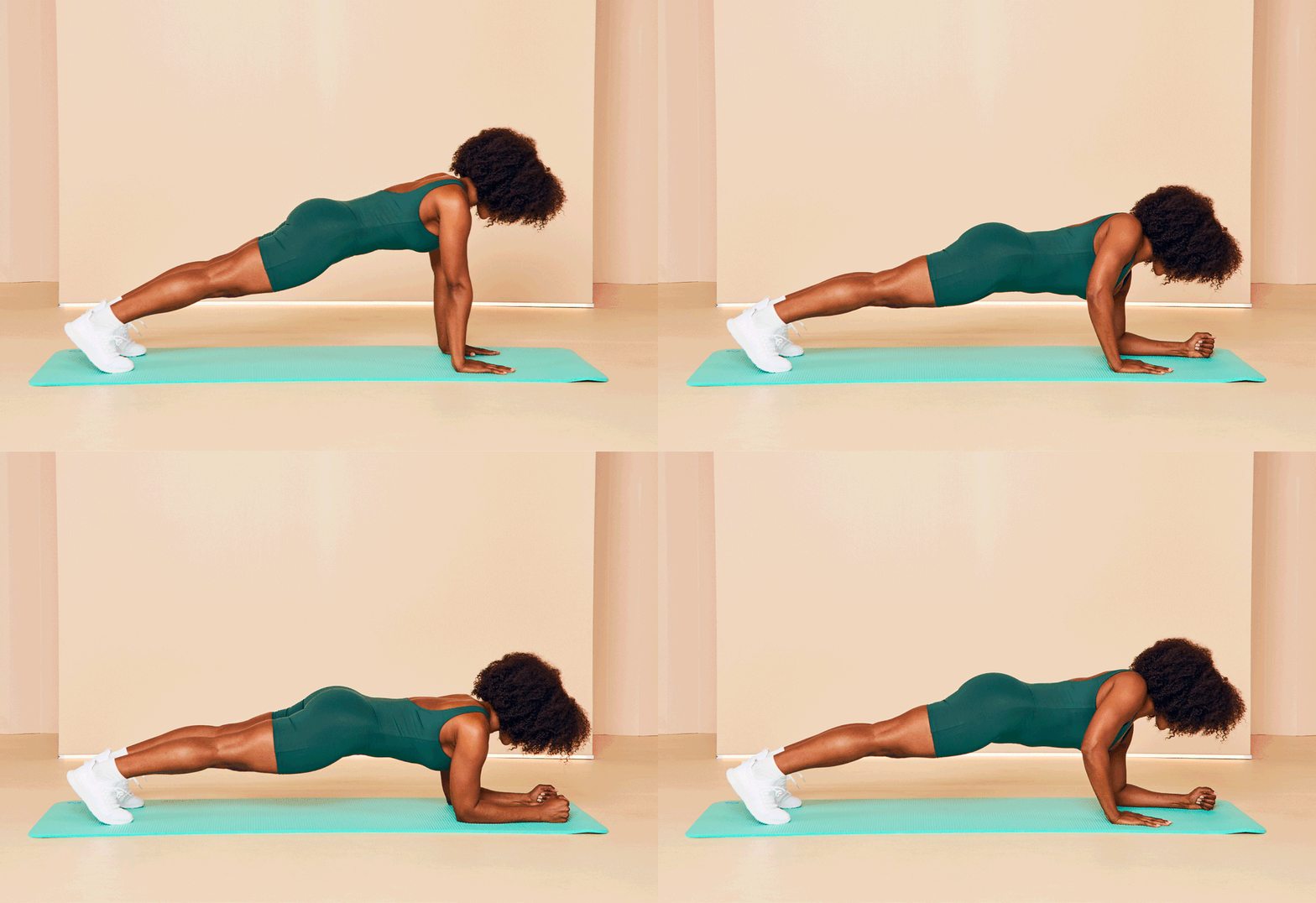
Whether you call them "commandos," "plank up-downs," or "up-down planks," this moving plank variation taps into your high- and low-plank skills. You'll feel this one in your shoulders as well as your core. (If this hurts your forearms or elbows, try adding a towel underneath them for extra padding.)
- Start in a high plank position with your feet shoulder-width apart.
- Lower your right elbow to the floor directly below your shoulders, then do the same with your left, coming into an elbow plank.
- Place your right hand on the mat, and straighten your right elbow. Do the same on the left to return to a high plank. Throughout the movement, try not to leg your hips pike up or rock from side to side.
- That's one rep. Repeat, starting the next rep with your left arm. Do three sets of 10 reps alternating arms, resting for 30 seconds to one minute between sets.
Lauren Mazzo [17] was the senior fitness editor at PS. She is a certified personal trainer and fitness nutrition specialist through the American Council on Exercise. Prior to joining PS, she worked for six years as a writer and editor for Shape Magazine covering health, fitness, nutrition, mental health, sex and relationships, beauty, and astrology.