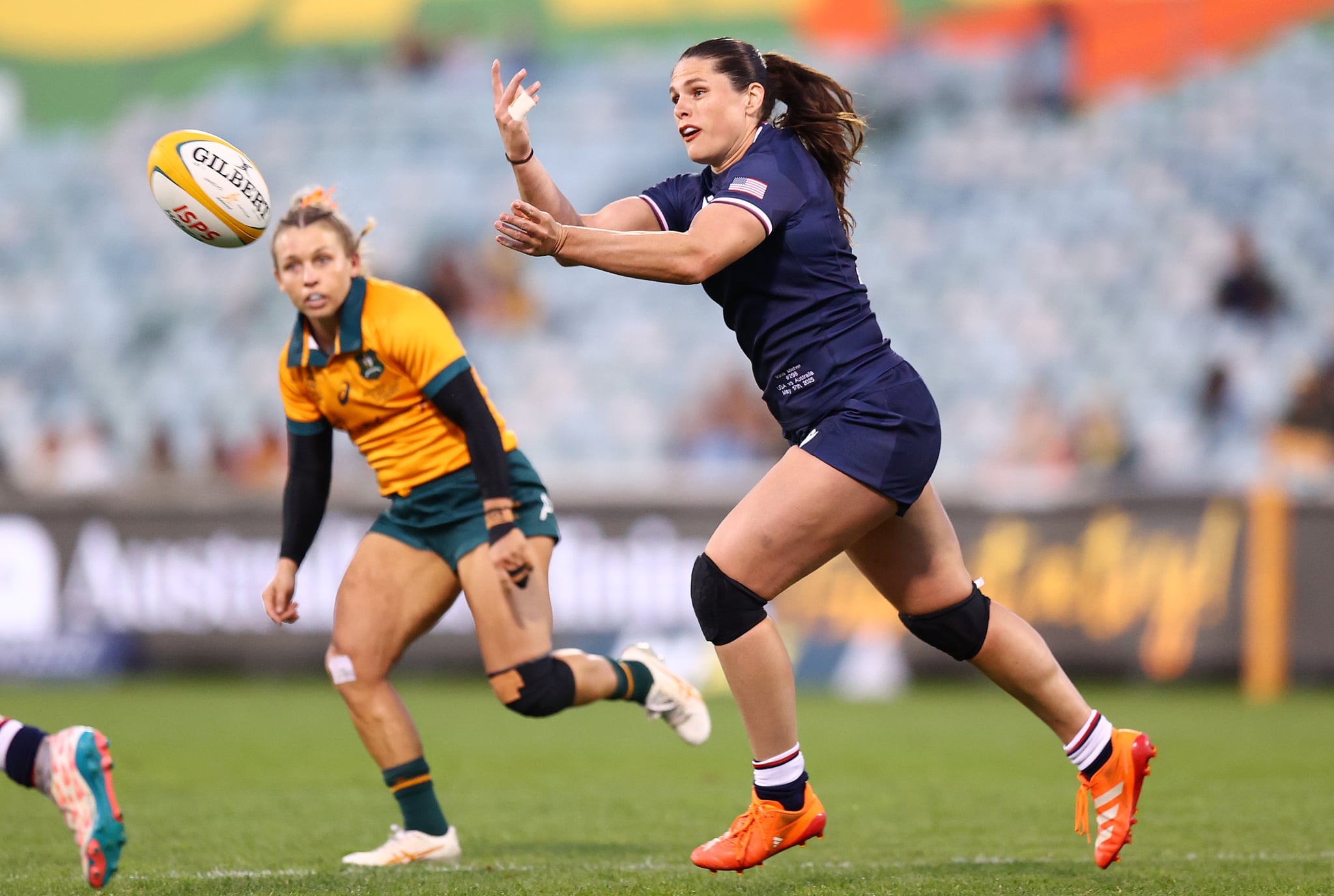
 The Women's Rugby World Cup is here [1] and if you're not tuned in, then what are you doing? If you're thinking to yourself, "wait but rugby is so confusing and I'm only watching for Ilona Maher [2]" — that's OK. Maher already warned fans the game would be confusing and still implored people to support the tournament. "Watch it, tune in. You're not going to understand it the first time you watch it. You're onto going to understand it the second time either, but just keep watching," she said during her ESPY Awards acceptance speech in July [3]. Lucky for you, we're here to help explain some of the ins and outs of the sport.
It's no secret that rugby has seen a huge spike in attention following the Paris 2024 Olympics, when the US Women's Sevens Team brought home the bronze (the team's first time medaling at an Olympic Games). But it's also understandable if the rules of the sport are still a bit overwhelming. For starters, rugby is built on strength, grit, and speed; it's not football, but it has all the action-packed elements. If you're interested in learning more about the rules of rugby, we've got you covered. Here's an easy-to-follow primer to help you take your burgeoning fandom to the next level.
What Are the Types of Rugby
Rugby comes in two main styles: Rugby Fifteens and Rugby Sevens. As the name implies, in Rugby 15s, you've got 15 players on each team going head-to-head for 80 minutes (two 40-minute halves).
Meanwhile, Rugby 7s has seven players per side, and matches are just 14 minutes (with seven minute halves). It's short, intense, and incredibly fun to watch — and is the form of rugby played at the Olympics.
What Are the Rugby Players and Positions
Both Rugby 15s and Rugby 7s have forwards, who are responsible for more attacking and hitting, and backs, who tend to be faster players, responsible for most offensive and defensive play. Forwards also compete for possession of the ball in scrums or line-outs (both methods of restarting the game after a stoppage due to a minor infraction or an out-of-bound ball).
In 15s, there are eight forwards (wearing jersey numbers 1-8) and seven backs (numbered 9-15). In 7s there are 3 forwards and 4 backs.
Rugby Position Names
In addition to forwards and backs, rugby player positions can be further broken down into the following roles. Each player is meant to take a specific position during gameplay, or take on certain duties, such as kicking or decision-making.
Forwards:
- Loose-Head Prop
- Hooker
- Tight-Head Prop
- Second row
- Second row
- Blindside Flanker
- Open side Flanker
- Number 8
Backs:
- Scrum half
- Fly-half
- Wing
- Inside Centre
- Outside Centre
- Wing
- Fullback
What to Know About the Rugby Pitch
The rugby playing field, also referred to as the pitch, is a wide and long playing surface made of grass. This massive field is 74 yards wide and approximately 103 to 109 yards long (from goal line to goal line). Here's an overview of the field markings on the rugby pitch. We know this is a lot of terminology, but knowing the various lines on the pitch makes understanding game play much easier.
The Field Markings
- The touchlines: Equivalent to the sideline of the field, the touchline runs the entire length of the field and indicates the boundaries of the pitch.
- The deadball lines: If the touchlines indicate the boundaries of the length of the pitch, the deadball lines, which mark the back of each in-goal area, indicate the boundaries of the width.
- The goal lines or try lines: These lines run perpendicular to the touchlines and parallel to the deadball lines, marking off an in-goal area that's about 11 to 24 yards wide (depending on the level of play and field dimensions). This end of the field generates the most excitement in the game as teams can score on tries
- The 22 meter lines: These lines run parallel to and about 22 meters in-field from each try line. This is where penalty kicks, scrums and lineouts take place.
- The halfway lines: Running down the middle of the field, these lines are where gameplay starts and where restarts occur after a try is successful.
- Dashed lines: A handful of "dashed" rather than solid lines on the rugby pitch indicates specific distances used during gameplay. For instance, drop-kicks (which start the game) must go beyond a 10-meter dash line to officially begin gameplay, and on throw-ins the ball must pass a 15-meter dash line before it can be played by anyone.
What Are the Rules of Rugby?
Now that we understand the terrain and how teams are made in rugby, here's how the game is actually played.
The objective of rugby is to score as many points across your opponent's goal line as possible before time expires.
Each game starts with a drop kick that must stay in the playing area and travel past the ten-meter line. While in play the ball can be carried with one or two hands, passed down the field, or kicked as players attempt to score.
Here's the kicker: the ball can be carried or kicked forward down the field, but it can only be passed backwards and sideways. It can be passed as often as a team wishes. And the opposing team can tackle, push, hold, or grab the player in possession of the ball — but only the player in possession. All in all, it's very much a team sport.
When play stops, it restarts with a scrum or a line-out. Scrums, which occur after minor infractions, look kind of like American football huddles, but more chaotic. Eight players from each team lock together in a three-row configuration, facing and binding with the opposing team's front row. The scrum-half tosses the ball into the tunnel formed by the players' heads, and the forwards fight for possession. It's as intense as it sounds.
A line-out occurs when the ball goes out of bounds. Both teams line up near the sideline, and the ball is thrown back into play. Players can jump or be lifted by teammates to catch it.
How Does Rugby Scoring Work?
Again, each team is trying to score as many points as possible during the game. Here's how points are awarded:
- Try (5 pts): This happens when the ball is brought to the ground over the opponents' goal line.
- Conversion (2 pts): Similar to American football, a team can attempt to score two more points after scoring a try by kicking the ball in between the goal posts.
- Penalty (3 pts): A team may choose to kick a goal when awarded a penalty after an infraction.
- Drop Goal (3pts): A player can kick for this goal during open play by dropping the ball onto the ground and kicking it as or just after the ball touches the ground, known as kicking the ball on the half volley.
D'Annette Stephens [4] is a PS contributor, certified personal trainer, and former volleyball player and coach.