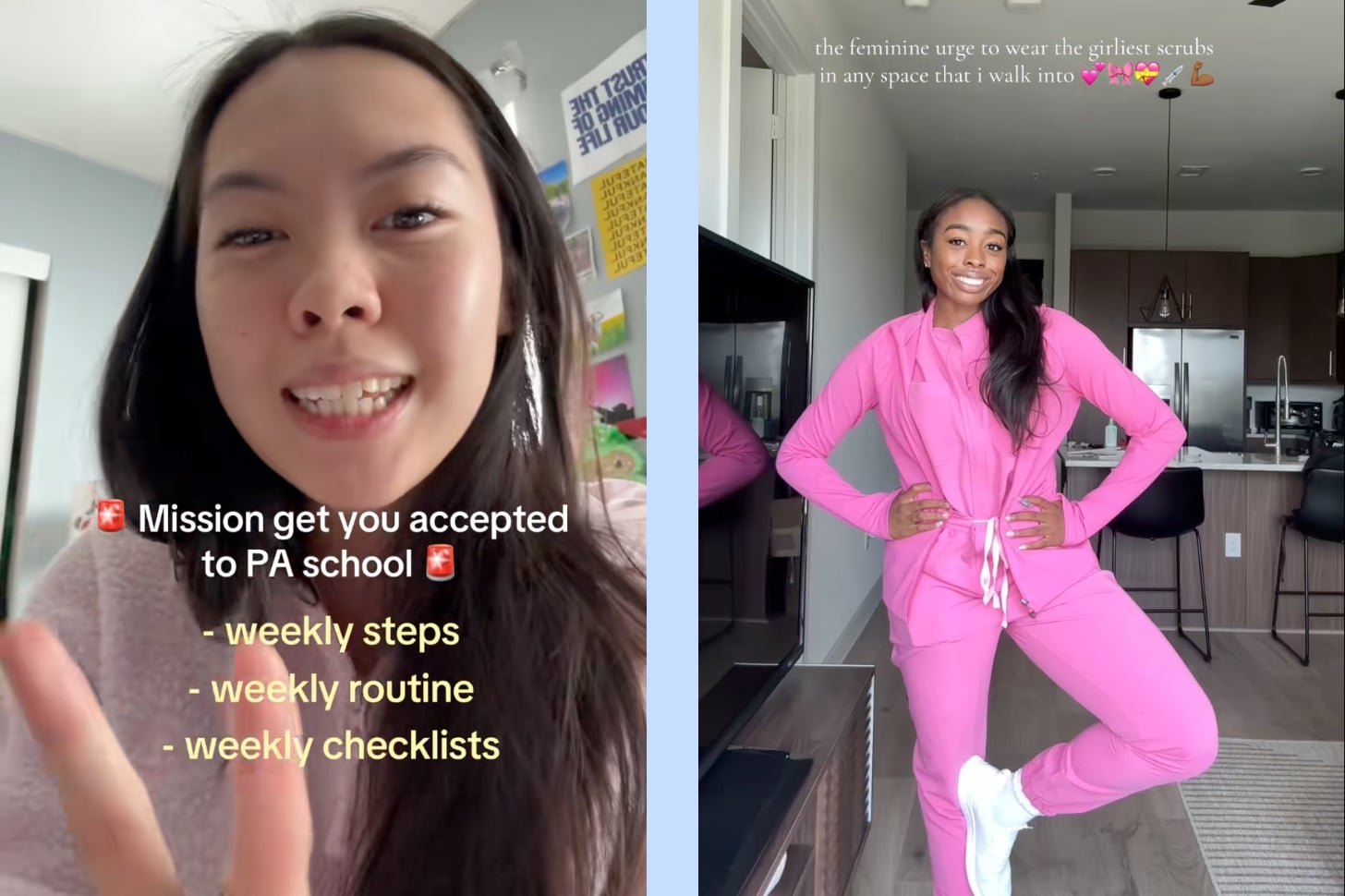
Tiffany Nguyen isn't a regular healthcare provider, she's a cool one. With a tooth gem on her top left incisor and vibrant acrylic nails, she's approaching the world of healthcare from a wildly authentic perspective — in true Gen Z fashion. Nguyen has 24.8K followers on TikTok [1], where she's built a community as "your pre-med older sister" and shares real-talk tips about becoming a physician assistant.
She's also part of the latest Gen Z healthcare providers entering the workforce and reshaping what it means to hold a career in this field. They're not chasing the "Grey's Anatomy" fantasy of a provider who lives at the hospital and has no personality outside of their white coat. Like most generations, this one has its stereotypes, but these young healthcare workers are breaking them daily, embracing this role with authenticity, balance, and a life beyond the hospital. Lucky for us, we get to watch them document it all as they show us what it means to build a career in medicine without leaving themselves or their patients behind.
The Stories They Carry
Nguyen's online persona is bold and bubbly, infused with Gen Z humor. But it only tells part of her story. At 24 years old, the PA-in-training documents her daily life on social media while carrying the weight of her family's experiences with her.
Nguyen was raised in a first-generation Vietnamese immigrant household with her mom and grandma, neither of whom finished formal education. "I have seen what it's like to not be represented in healthcare," Nguyen says.
"I want to be the PA who represents the Asian American, low-income, non-English speaking identities."
"My grandma doesn't even know how to read. My mom didn't even finish high school. . . . I haven't seen any medical provider that looks like me in Ohio since I've grown up and to be taken care of [by] medical providers who don't represent or look like you and who don't understand the language that your whole family speaks . . . it's isolating."
Nguyen has been the de facto medical advocate of the family since age 10, often translating complex diagnoses, treatments, and care plans. It's what led her to volunteer at the Asian Free Health Clinic during her time at Ohio State University and ultimately to pursue a career in medicine at the University of Southern California.
@firstgenpa [2] #paschool [3] #medstudent [4] #premed [5] #medtok [6] #nursingstudent [7]
♬ original sound - TIFFANY NGUYEN, PA-S :D [8]
"I want to be the PA who represents the Asian American, low-income, non-English speaking identities," Nguyen says. "And I know that when I speak, I carry my family and my patients' voices with me."
When asked if the weight of that responsibility ever feels overwhelming, she responds immediately: "I'm constantly driven by the quiet power of representation." But that sense of responsibility was even more resonant when Nguyen became a patient herself after suffering a hemorrhagic stroke (brain rupture) in April. The incident left her temporarily immobile and unable to speak. Her biggest concern during recovery? Money. "My mind was not fully conscious in the ICU right after the brain surgeries that I had, but it was conscious enough to be worried about how much is this going to cost?" she says. "As a first-generation, low-income student, I'm constantly calculating . . . even healing felt like a luxury that I could not afford, and so I carry that with me wherever I go."
Nguyen's story challenges some of Gen Z's most common stereotypes of being lazy, self-absorbed, or fragile. Aishwarya Addepalli, a 27-year-old second-year resident, views her generation as the complete opposite.
"They think that you're young and not necessarily as disciplined or mature," she says. "But I think it's actually the other way around." She considers her generation to be deeply self-aware, shaped by the context around them, and driven by a strong sense of purpose.
A Generation That Refuses to Choose
Gen Z is one of the most resilient generations, Addepalli says. "We've gone through a lot" — from the era of 24/7 social media access to the educational and social disruptions of the COVID-19 pandemic. "We've gone through so much change in the world during our lifespans," Addepalli adds.
"We still deeply care about people, patients, but we're also more intentional about surviving and taking care of ourselves."
It was just six years ago that Addepalli was in her junior year of college, quarantined at home and doing Zoom interviews for medical school. That's when she started making dance content like the rest of us, lonely and confined. Only hers was good — and it went viral. One of her most popular videos — a Bharatanatyam-style combination [9] to Doja Cat's "Woman" — garnered more than 18 million views, 2.7 million likes on TikTok, and a Spotify cover image. But Addepalli didn't start dancing on social media for recognition. She's been dancing Bharatanatyam since she was a kid, and it has always served as a mental health resource, especially now as she's in residency as an anesthesiologist.
"Dance was always an outlet for stress, for physical health, and it was honestly very meditative as well. I talked about this even when interviewing for medical school," she tells Popsugar.
@aishuadd [10] the duality of being a dancer girlie in medicine #chalant [11] #telugu [12] #doctor [13] #medicine [14]
♬ original sound - Playboi Teluguabbayi [15]
That's the thing about being a Gen Z doctor-slash-creator: unlike generations past, they're unafraid to bring their whole selves to work and prioritize who they are outside of the job. "I try not to think of it as better or worse, we're just different as a generation," Addepalli says.
"We still deeply care about people, patients, but we're also more intentional about surviving and taking care of ourselves," she adds. In other words, "instead of making our career our entire life and personality, we use other aspects of our lives to help us become better at our careers."
Take Erica Ogwumike, a 28-year-old resident physician, as an example. Although she pursued medicine, athletics has always been central to her life — she comes from a family of elite athletes, including WNBA standouts Chiney and Nneka Ogwumike — and she didn't give that up to be a dermatologist. In fact, Ogwumike majored in health sciences, policy studies, and Spanish while pre-med and playing Division I college basketball; competed in the Tokyo Olympics while in medical school; and has been a content creator documenting it all since 2018 with 93.5K followers on TikTok [16] today.
"In my generation, it was definitely emphasized to be very multidimensional and to not limit your interest just because you want to be a doctor," Ogwumike says.
And while Ogwumike may be on the extreme side of multidimensionality, her colleagues aren't too far behind. "You'll have doctors who were ballet majors, dance majors, art history," she says. "And yes, that did exist before, but I think now it's becoming way more the norm."
@ericathemd [17] def due for our quarterly FaceTime chats, yall I’m about to be half way done w residency!!! nuts #dermresidency [18] #updates [19] #sephorahaul [20] #doctor [21] #skincare [22]
♬ original sound - Erica The MD [23]
Happy Provider, Healthier System
This work-life-passion balance Ogwumike alludes to is one of Gen Z's biggest strengths. It's a side effect of growing up in a time "where wellness was prioritized," she says. "I can't think of a time in college or high school where wellness wasn't a part of our curriculum and emphasized."
In generations past, Ogwumike says healthcare providers went above and beyond to live up to the term "resident," working round-the-clock to meet the 19th-century expectations of the always-on provider. For Ogwumike's generation, things are much different.
Not only are there work-hour rules to prevent overworking, but she and her colleagues just don't subscribe to the old mentality. And that doesn't make them any less qualified to do the job. In fact, conversations with these three providers suggests the opposite: drawing clear boundaries between work and the rest of your life doesn't signal a lack of commitment — it's what allows them to show up fully for their patients. For anyone who has felt dismissed by a healthcare provider, that couldn't be more important.
"I want to help my patients to the best of my ability, but at the same time, I know I can't help them if I don't take care of myself," Ogwumike says.
In other words, this generation of healthcare providers is all-in on well-being — not just for their patients, but for themselves. They refuse to sacrifice identity, passion, or health for this job. Instead, they use those three pillars to make themselves even more empathetic, capable, and well-rounded providers. Welcome to the Gen Z era of healthcare. Any one else excited to be here?
Alexis Jones [24] is the section lead of the health and fitness verticals at Popsugar, overseeing coverage across the website, social media, and newsletters. In her seven-plus years of editorial experience, Alexis has developed passions for and expertise in mental health, women's health and fitness, racial and ethnic disparities in healthcare, and chronic conditions. Prior to joining PS, she was the senior editor at Health magazine. Her other bylines can be found at Women's Health, Prevention, Marie Claire, and more.