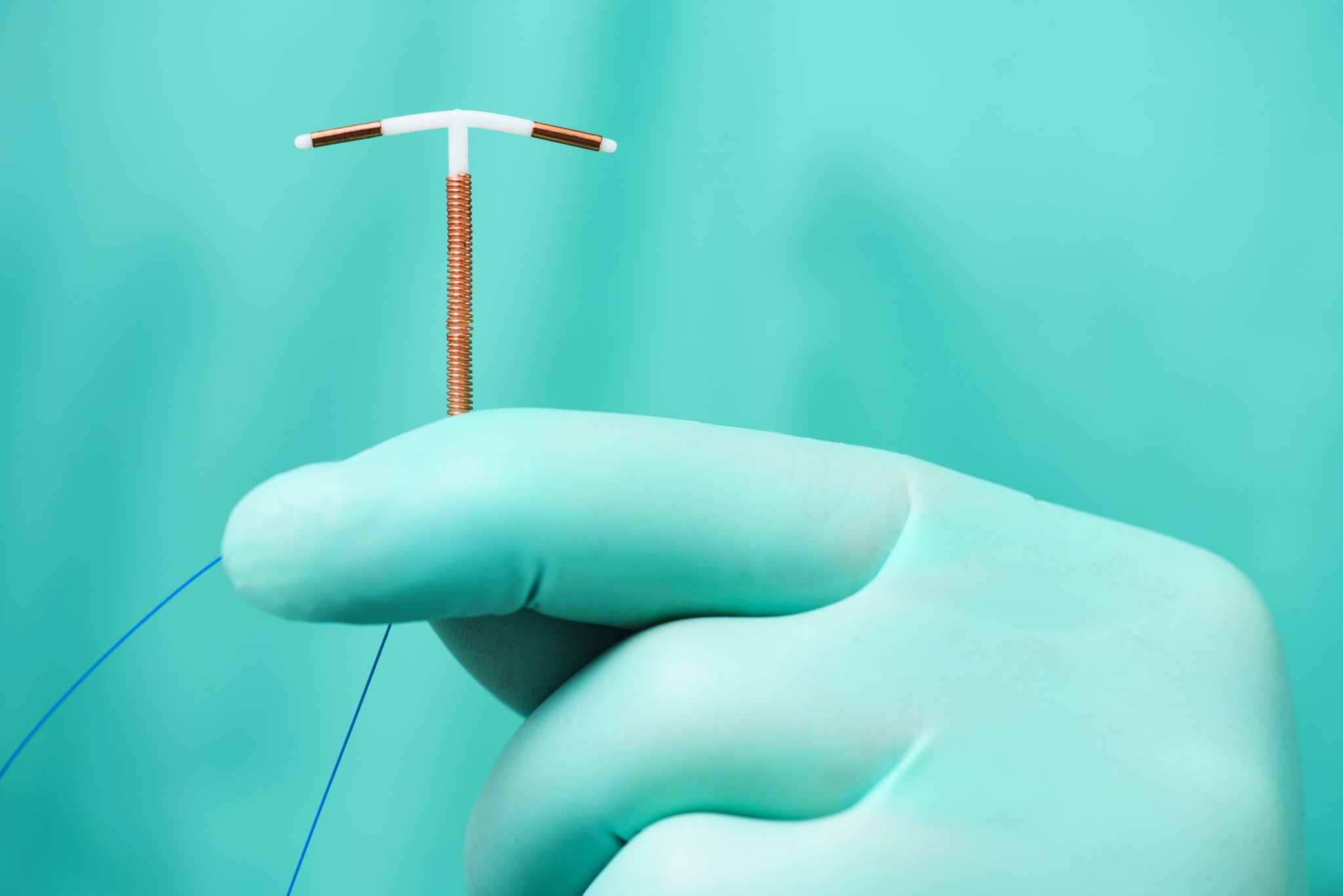
"Excruciatingly painful" — that's how PS producer Jordan Shalhoub describes [1] their first attempt at getting an IUD. The insertion was so uncomfortable that ultimately it failed and Shalhoub left without an IUD. The second time around, their doctor offered up several options for pain management — valium and a paracervical block (or a local anesthetic injected into the cervix) — neither of which Shalhoub knew were possible for IUDs. This time, Shalhoub says the process was "way more manageable," with quick bouts of pain and discomfort, but it was ultimately "a breeze" compared to the first attempt.
Sadly, this type of more positive experience with IUDs hasn't always been a thing. For years, IUD insertion pain has been continually dismissed — just scroll through #IUDexperience [2] on TikTok you'll find plenty of anecdotal evidence.
"Getting my IUD inserted hurt worse than my C-section did," says Caitlin Kavanaugh, a mother to twins. "Having not gone through labor, I had no idea what cervical dilation felt like. I remember feeling like I had to dissociate from my body to make it through." Similarly, Myra Chavez tells PS that her second IUD insertion hurt worse than her three vaginal, unmedicated births. Another patient, Heaven Taylor, says that she fainted upon standing up after the procedure.
But why does IUD insertion hurt so much? And what's being done to mitigate the pain.
As of May 2025, the American College of Obstetricians and Gynecologists (ACOG) has officially released new guidelines [3] encouraging doctors to take IUD (and other similar procedures) pain more seriously by providing more (and better) options to manage pain. The new guidelines follow the CDC's updated guidelines [4] for IUD pain management, which were released in August 2024. The CDC guidelines came to a clear conclusion: doctors can (and should) be doing more.
"There is an urgent need for health care professionals to have a better understanding of pain-management options and to not underestimate the pain experienced by patients and for patients to have more autonomy over pain-control options during in-office procedures," the ACOG writes in the new guidelines.
The ACOG also calls out the fact that systemic racism and bias has played a factor in how pain management has been historically managed, which is even more reason why it's time for doctors to do better and take this in account with the new guidelines.
In terms of the actual pain management options that are now recommended by ACOG, the list of guidelines has expanded beyond a topical lidocaine cream and includes more options, including a paracervical block and anesthesia (I'd personally prefer to be sedated over having to get injections into my cervix — but to each their own).
These updated guidelines are definitely a start, but many patients find it disheartening that it's taken so long to receive official guidelines. A 2023 study in the journal "Obstetrics & Gynecology [5]" analyzed TikTok's 100 most popular IUD-related posts, including 31 that highlighted patients' experience with insertion or removal; of the latter, "all had a negative or ambiguous tone and 96.8% highlighted pain," the study authors wrote.
"The trending TikTok videos documenting . . . painful experiences and medical gaslighting [6] around IUD insertion . . . highlight a real problem of female pain not being taken seriously," says Melanie Bone, MD. This, she says, can erode patient trust in their doctors and the medical system. This was also reflected in the Obstetrics & Gynecology study, with over a quarter of creators expressing distrust towards their providers and some instances of having their experiences invalidated or denied.
No one deserves to have their pain ignored or invalidated — and that includes you. So here's what experts have to say about IUD pain, and what you can do to protect yourself if you're interested in getting (or removing) an IUD.
Experts Featured in This Article
Melanie Bone [7], MD, is a consultant ob-gyn and US Medical Director at the gynecological health company Daye [8].
Michael Reed [9], MD, is an ob-gyn and cosmetic gynecologist based in California.
Stephanie Hack [10], MD, is an ob-gyn, podcast host, and public speaker.
Gunvor Ekman Ordeberg [11], MD, is an ob-gyn and co-founder of DeoDoc Intimate Skincare [12].
Why Is IUD Insertion Painful?
Pain is subjective, and some individuals may find IUD insertion or removal more or less uncomfortable than others. But it's clear that many people find the procedure to be borderline agonizing.
Stephanie Hack, MD, an ob-gyn, explains that multiple steps during an IUD insertion are "uncomfortable, due to the need to manipulate and pass through the cervix." The worst pain occurs "the moment the IUD passes through the cervical canal into the uterus," Dr. Hack says, adding that patients describe this as a sharp pain or cramp that can last for a few minutes.
Michael Reed, MD, notes that the instruments used also play a role. The tenaculum (gynecological forceps that are used to stabilize the cervix during IUD insertion by pinching the tissue) has scarcely been updated since the Civil War era, she says. It has sharp ends that can cause cramping and bleeding.
Why IUD Pain Is Under-Addressed
Even if some people tolerate IUD pain well, it's clear that others find the procedure to be debilitating. So why isn't the pain better managed? "The [macro-level] answer is simple: women's health is not a priority of big pharma," says Gunvor Ekman Ordeberg, MD.
There's a general focus on IUD efficacy over patient experience, Dr. Bone says. There's also an established gender bias in medicine toward women's pain, and especially toward Black and Latina women's pain — sometimes called the Gender Pain Gap — that leads to it going dismissed and overlooked. As a result, there's a lack of evidence-based research into IUD pain management. Plus, that research isn't being prioritized by professional societies like the American College of Obstetricians and Gynecologists, which would help doctors devise better treatment plans and get IUD pain management covered by insurance companies, Dr. Bone says.
As a result, until recently, there's been no standard protocol for managing IUD insertion pain, according to a 2024 review published in the journal "Cureus." Prior to the Aug. 8 update, the CDC's guidelines were undefined, stating that a lidocaine injection — a technique that's been shown in a study in "Obstetrics & Gynecology" to ease IUD discomfort — "might reduce" IUD insertion pain.
The latest ACOG recommendations are expanded to include topical lidocaine as well as paracervical blocks and anesthesia. The guidelines also encourage practitioners to counsel their patients on the pain they might experience and about their different pain management options to come up with an individualized plan. The hope is that the expanded guidance will help standardize pain management protocols.
In the absence of a standard protocol, different medical practices take different approaches toward pain management. For instance, Kerry Giannantonio says her doctor rescheduled her insertion appointment to prescribe an intravaginal pain tablet to improve her experience. But Kavanaugh, who considered her IUD insertion to be more painful than her C section, was counseled to "take a dose of Ibuprofen" when she proactively inquired about pain management before her appointment. It clearly didn't make much of a dent in Kavanaugh's pain, and in fact, Dr. Reed tells PS that Naproxen and ibuprofen are not shown to help with insertional pain, only post-procedure discomfort.
The Other IUD Pain Problem
Dr. Ordeberg and her research team believe the unmanaged pain of IUD insertion goes beyond the repercussions of individual discomfort and medical distrust. It deters people from using the long-acting reversible contraceptive altogether. Dr. Hack agrees that there are many people opting for other forms of birth control due to the pain of IUD placement at medical practices.
This is discouraging because the IUD does have many advantages. It's the most effective contraceptive when it comes to preventing unwanted pregnancies. It also comes in a non-hormonal option, for those who don't tolerate hormonal birth control well.
The bottom line: "Pain management should be offered to all patients considering an IUD," Dr. Reed says.
Dr. Bone agrees, noting, "the medical community needs to believe pain experiences and to proactively discuss and manage patient pain. Normalizing pain relief can help make IUDs a more attractive option, producing positive contraception experiences for patients."
What You Can Do to Make IUD Insertion More Bearable
The best way to go into any doctor's appointment is prepared. Be ready to advocate for yourself and what you need to be comfortable. For an IUD insertion, experts recommend the following:
- Don't be afraid to ask for pain management: "A good physician will be open to discussing and providing appropriate pain management strategies," says Dr. Hack, especially in light of the updated guidelines. Dr. Bone adds that you should not be intimated to ask why they aren't offering a solution. If your physician pushes back or if they refuse, Dr. Hack encourages you to seek a second opinion.
- Come armed with specific asks: It can be useful to bring up specific pain management strategies so that you can get specific answers about why it may or may not be a good option for you, Dr. Reed says. He names the following pain management options to know about: "There's evidence-based research that shows that ketorolac [an NSAID] helps with insertional and post-procedure pain," he says. "Other options that can help to make the insertion less painful include local analgesia like numbing creams or paracervical blocks and cervical ripening agents." Contrary to what you might expect, Dr. Reed says that placement during a menstrual cycle might also make the procedure less painful, due to the cervix being slightly opened.
Ultimately, the hope is that doctors will be the ones providing these options to you. But if they don't, know that your concern over IUD pain is valid and there is effective pain management available to you that can go a long way toward ensuring you have a positive IUD experience.
— Additional reporting by Chandler Plante and Mercey Livingston
Jessica Ourisman [13] is a freelance beauty and wellness editor who frequently writes about skincare and cosmetic dermatology for PS, Harper's Bazaar, Allure, InStyle, The Zoe Report, Coveteur, WWD, and more.
Chandler Plante [14] is an assistant editor for PS Health & Fitness. Previously, she worked as an editorial assistant for People magazine and contributed to Ladygunn, Millie, and Bustle Digital Group. In her free time, she overshares on the internet, creating content about chronic illness, beauty, and disability.
Mercey Livingston [15] is a writer and editor with eight-plus years of experience covering fitness, health, and nutrition for media outlets and brands including Well+Good, Shape, and Women's Health. She was the fitness editor at Peloton and held editorial roles at Equinox, Shape, and Well+Good. Mercey is a NASM-certified personal trainer and women's fitness specialist. She's also a certified holistic health coach through the Institute For Integrative Nutrition, with an additional certification in hormone health.
