As a patient, navigating the medical field [1] comes at a cost. In exchange for treatment, you trade varying amounts of autonomy, following doctors' orders — which may include answering intimate questions, exposing parts of your body, and generally making yourself vulnerable in front of teams of strangers — all in the hopes they'll make you better. It's hard enough to feel like a real person when you're wearing a flimsy gown — but for some, clinical settings aren't just uncomfortable, they're downright degrading.
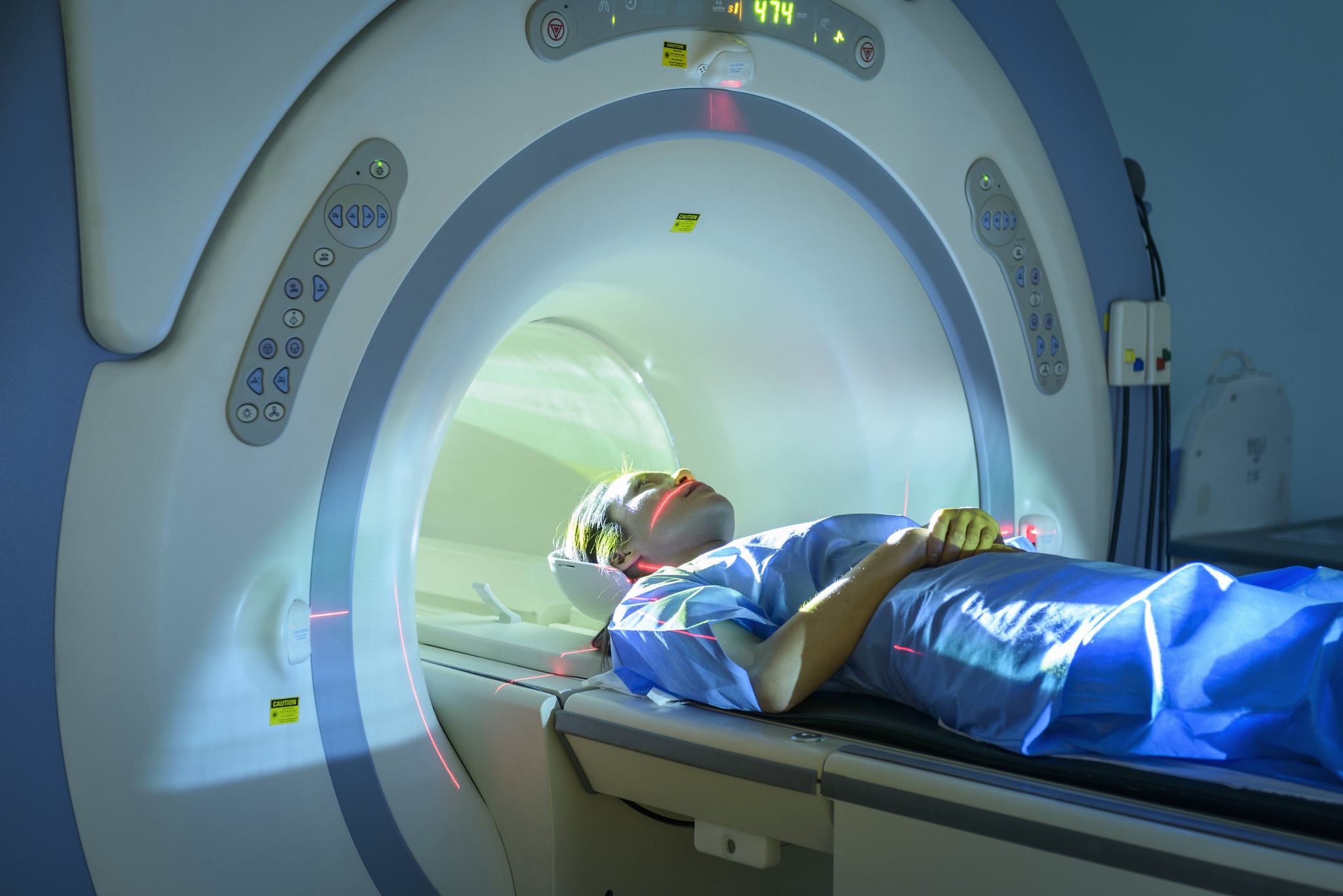
For people in larger bodies, dignified healthcare is so rare some patients actively avoid seeking necessary treatment. Speaking to this point, Tigress Osborn, executive director of the National Association to Advance Fat Acceptance (NAAFA), recalls her own experience getting an MRI as a person in a larger body. "The machine itself was big enough for me, but it also involved having to have a strap go across my chest. The strap was made out of a hard plastic, so there was no give to the strap, and it would barely click," Osborn tells PS. "In the middle of my procedure, the tech started lecturing me about how I was going to break her machine." Another time, after she was accidentally scheduled for a standard MRI instead of a wide-bore MRI (a machine with larger openings for the patient), she listened with her head in the machine as one of the techs told their coworker to "just push her harder."
Experts Featured in This Article:
Tigress Osborn [2] is an advocate for fat liberation and the executive director of the National Association to Advance Fat Acceptance [3] (NAAFA).
Angel Austin [4] is the founder of Sacred Space for Fat Bodies [5], and interim executive director of the Association for Size Diversity and Health [6] (ASDAH).
Esther Tambe [7], RD, is a weight-inclusive dietitian and nutritionist.
MRI Weight Restrictions
Osborn's story is not uncommon, although these incidents are seldom addressed with the appropriate level of concern. Specific weight restrictions vary depending on the hospital, equipment used, and type of scan. But the limits for MRI and CT machines typically range from 350 to 450 lbs, according to a report in the journal "Obesity [8]." Higher-weight bearing machines are manufactured [9], but they're generally not found in hospitals. Thus, patients in larger bodies are sometimes sent to zoos or veterinary facilities just to receive necessary imaging.
It's bizarre to think that, in a country where nearly one in three adults are considered overweight, per the National Institute of Health [10], we're so content to treat larger patients like animals. Despite the amount of patients in larger bodies, a study published in "The Obesity Society [11]," found that the overall national sample with access to larger-weight capacity CT equipment is only 10 percent (5 percent for rural hospitals and 3 percent for critical-access hospitals). Another study published in the journal "Patient Safety [12]" reported that, in an analysis of 107 events related to patients in larger bodies, MRI and CT scanners were involved in nearly 50 percent of reports. Of the events studied, 75 percent led to a delay in care, while 41 percent caused temporary harm to the patient.
"It is not just access. It is, 'I am purposefully making sure that the message is sent to people of a certain size that you do not have value in these systems, that you not belong, and that if you're quote unquote too far gone, it's not our responsibility to help you,'" says Angel Austin, interim executive director of the Association for Size Diversity and Health [13] (ASDAH). The underlying issue, Austin argues, is that some medical professionals view people in larger bodies as complicit in their own illness — therefore, they aren't seen as deserving of care.
Assumptions About Patients
One 2019 scoping review of 21 different studies published in the journal "Primary Health Care Research & Development [14]" describes the medical treatment of people in larger bodies as "contemptuous, patronizing, and disrespectful," noting that some providers also seemed to make assumptions about weight gain and attributed all health issues to excess weight. Another article from the "Postgraduate Medical Journal [15]" points out that certain characteristics — including laziness and carelessness — are frequently assigned to heavier patients, perpetuating the idea that people with obesity are solely responsible for whatever health condition they may be seeking help for.]
"Usually those in larger bodies or presumed to be lazy, noncompliant, unattractive, not worthy," Tambe says. "But also, just thinking about [the fact that] weight discrimination is legal [16] in 47 states. You can lose a job because of your weight. You can get paid less because of your weight."It doesn't help that weight bias is pervasive, not just IRL but on social media, too. Online, medical professionals share the disrespectful treatment of larger patients like a fun fact. "If you order a CT scan or MRI machine, sometimes it can't be done because of weight restriction," PCCM doctor Neena C says in a TikTok [17] with over 600K likes. "If you are over a certain weight to some hospitals, we have to send you to the zoo in order to get the scan done."
"Yes, a hospital I used to work at would send [the patients] out to Sea World," one commenter confirmed under the original TikTok. "Already needing medical attention and then being told I would have to have it done at the zoo would literally be my final straw," another commenter added.
The Consequences
Incidentally, many people in larger bodies already avoid medical care due to body-related shame [18]. The weight bias waiting for them at the doctor's office and inside emergency rooms adds another layer of stigma. "You can't have a top-10 diagnosed disease in this country if you're fat without being attributed to your weight," Austin says. As a result, patients are delaying their appointments or skipping them altogether, she says, which could risk exacerbating their conditions. "A cancer that could have been detected at stage one, it's now stage four. Why? Because 'I didn't want to deal with the medical system. I didn't want to not be stigmatized. I didn't want to be judged,'" says Esther Tambe, RD regarding the mindset of certain patients.
The lack of dignified and inclusive equipment (which expands to blood pressure cuffs, wheelchairs, and hospital beds) is yet another deterrent for people in larger bodies seeking medical treatment. "When [healthcare workers] tell you, 'We don't have an MRI for you because you're too big,' what they do not say is, 'We don't have an MRI for you because our equipment is inaccessible,'" Osborn says. Due to these experiences, some patients will inevitably decide not do anything further to access care. Osborn says inequitable practices make patients think, "'These people are going to let me die anyway. What is the point of me going to these facilities and being traumatized?'"
"I'm not sure anybody cares if we die."
Without immediate access to higher-weight bearing machines, patients in larger bodies get slower, less dignified care, putting them at risk, especially in emergency situations. It can be a matter of life or death. "And again, it sounds so cynical, but I'm not sure anybody cares if we die," Austin says. "Because of what [larger patients] know they'll experience when they see a doctor [they] don't get the treatment they need or are not accommodated. They have a disease just like any other human person that goes untreated, that shortens their lives — diagnoses that they're not aware of or never get because they weren't able to receive the care."
In clinical settings, where uncertainty, anxiety, and fear already leaves most patients feeling vulnerable, underlying weight bias contributes to distrust, disproportionate levels of misdiagnosis [19], and reduced quality of care [20]. In reality, body size is complex and highly intersectional, with obesity affecting 54.8 percent of Black women [21] and 50.6 percent of Hispanic women (as compared to 38 percent of white women).
Solutions to Weight Bias in Healthcare
For change to occur, Osborn says that the healthcare system must first place accessibility over profit. "[One] argument is that the folks who really need [higher-weight bearing machines] are such a small percentage of the population," she says. In reality though, "in the US and in the western world, we have enough within our systems that we could redistribute resources within our systems to ensure that everyone in every kind of body with every kind of condition still got the care that they needed," Osborn tells PS. In an era of cutting edge-technology in which AI can help detect cancer [22], and diagnostic testing is rapidly expanding [23], it's hard to believe that our healthcare system can only shrug its shoulders and send an entire demographic on a trip to the zoo. Regardless of size, all patients deserve humane, dignified healthcare — one that begins and ends in an actual hospital.
Chandler Plante [24] is an assistant editor for POPSUGAR Health & Fitness. Previously, she worked as an editorial assistant for People magazine and contributed to Ladygunn, Millie, and Bustle Digital Group. In her free time, she overshares on the internet, creating content about chronic illness, beauty, and disability.
