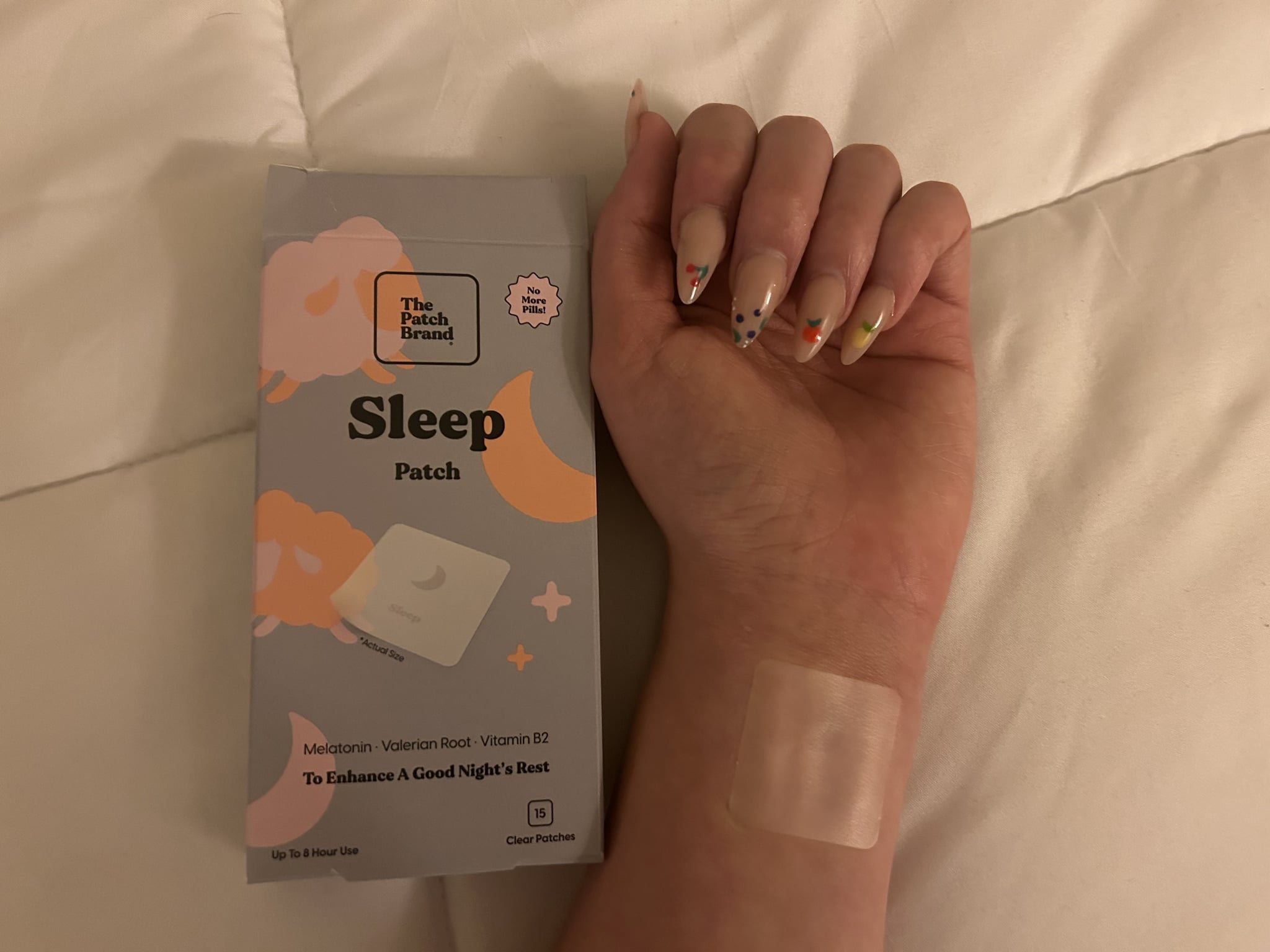
My chronic illness has conditioned me to dread bedtime. Having lost vision in my right eye and developed a painful inflammatory disorder [1] that tends to flare up at night, my sleep routine is already more complicated than most. Since my eye won't close on its own, I apply ointment and use a gentle medical tape to seal it shut. I open the strategically placed prescription bottles on my bedside table with bored familiarity. Two different sleeping masks rest on top of my bed frame just in case I wake up with increased light sensitivity. From the outside looking in, it seems as though I've mastered the prep work required for a good night's rest. But it's not always enough to help me drift off to sleep [2], especially when medical anxiety keeps my thoughts racing and my body restless. This is where The Sleep Patch comes into play.
The Sleep Patch [3] ($10, Previously $12) is essentially a transparent sticker that's supposedly infused with ingredients to help you fall asleep. Billed as a faster alternative to melatonin, you simply peel and stick one of the vitamin patches to your skin before bedtime to help usher [4] you into dreamland (minus any sleeping pills). Intrigued by the concept, especially as someone who struggles to fall asleep and stay asleep, I decided to try The Sleep Patch for myself.
What to Know About Vitamin Patches
When you develop a complicated chronic illness, some people (including providers) will encourage you to try anything in the pursuit of a cure [5] . . . even if the treatments are only backed by anecdotal evidence. This cure-it-yourself stance had the opposite effect of making me slightly apprehensive of integrating supplements into my personal routine. And that instinct isn't misplaced.
"Vitamin patches are not regulated by the FDA. This means that we can't medically guarantee the safety or effectiveness of these products," says Natasha Bhuyan, MD [6], provider at One Medical. Vitamin patches specifically aren't even subject to the level of oversight supplements undergo, because in order for a product to be considered a supplement, it must be meant for ingestion. "As a result, consumers should do their own research about what they are purchasing," Dr. Bhuyan says.
Assuming these patches are reporting all ingredients accurately (which isn't guaranteed), their efficacy is still up for debate. There's some research looking at how effectively transdermal patches deliver nutrients, but not enough to say for sure whether or not they work. A very small, 2022 study of 92 people in the journal Cureus [7] found that people who used transdermal multivitamin patches after gastric bypass surgery (which leaves people at risk of nutrient deficiencies) often had micronutrient deficiencies; but due to the size of the sample, the research isn't conclusive. A 2021 review in the journal Metabolism Open [8] also noted that more research is needed before experts can say whether these patches are effective.
The main ingredients The Patch Brand claims are in its sleep patch are fairly straightforward — melatonin, valerian root, vitamin B2, among a few others — and I felt comfortable giving it a whirl. But to be safe, it's essential to discuss any new supplements or vitamin patches you're interested in trying with your healthcare provider first, especially considering that certain ingredients can interact with your existing medications.
With all that being said, here's how my experience with The Sleep Patch went.
What's In the Sleep Patch?
Before trying this patch for yourself, it's important to know what's in it. According to The Patch Brand website, its main ingredients include:
- Melatonin (3 mg): If you're interested in trying melatonin to see if it improves your sleep, the Cleveland Clinic [9] recommends starting at one milligram and increasing that dose by one milligram as needed (never exceeding 10 milligrams). This patch, however, uses 3 milligrams. While that's not a megadose, it's worth noting that taking too much melatonin [10] at once can lead to nightmares, headaches, and even abnormal activity of the immune system over time. And, of course, we still don't know how well melatonin is absorbed through the skin via a transdermal patch. "Be vigilant about the dosage of melatonin in the patches compared to pills," Dr. Bhuyan says. "It's best to use the lowest dosage possible to help with sleep."
- Valerian Root Extract (4.5 mg): Early research suggests valerian, an herbal supplement, may help improve sleep by increasing the amount of gamma aminobutyric acid (GABA) in the brain, effectively calming anxiety, according to Mount Sinai [11]. That said, safe dosage is still unclear, and the Mayo Clinic [12] says valerian may be most effective after two weeks of consistent use.
- Passionflower Extract (3.5 mg): Historically, passionflower extract was used as a sedative. In modern medicine, it's used as a treatment for anxiety, sleep, and pain, according to the National Institute of Health [13]. It's often used in conjunction with valerian or lemon balm, according to Mount Sinai [14], and although research is still limited, it's also thought to increase GABA in the brain.
- Vitamin B2 (1 mg): Also known as riboflavin, B2 is one of eight B vitamins involved in energy production. Studies show vitamin B2 intake is also related to sleep quality [15], and possibly involved in melatonin production. The Recommended Dietary Allowance for women 19 years and older is 1.1 milligrams daily, according to Harvard School of Public Health [16].
- Magnesium Citrate (750 mcg): According to the Cleveland Clinic [17], magnesium supplements may make it easier to fall asleep, and they may also improve the quality of sleep in some people. "Brains love magnesium, and the mineral is a common co-factor in many processes that generate healthy amounts of brain neurotransmitters," Mattress Firm sleep advisor Chris Winter, MD [18] previously told PS [19]. "Having your magnesium levels tested and supplementing can be a big step in a healthier sleep."
- Vitamin D3 (15 mcg): Studies show that vitamin D3 plays a role in sleep regulation [20], but more research is still needed to prove that vitamin D supplements are an effective treatment for improving sleep quality. That said, vitamin D deficiencies are linked to sleep disorders [21] and poor sleep quality.
My Experience With the Sleep Patch?
I started by applying the sleep patch to a relatively hair-free section of my forearm 30 minutes before bedtime, per the instructions (pro-tip, don't go too close to your wrist, lest your nighttime skin care wipe the patch right off). My biggest concern was that I would wake up the next morning still drowsy, as was my typical experience with other sleep supplements, but I'm happy to report this was not the case.
In all honesty, the nights I used the patch were chaotic and free of any real sleep routine. The Sleep Patch had half an hour to combat a full day of stress, a very painful eyeball, and some incessant nighttime scrolling. (I just can't tear myself away!) Still, I felt like the calming effects started to kick in right around the 30-minute mark. To give the patch a real chance, I made sure I was already in bed at this point, alarm set, meds taken, and eyeball taped down. Each time I used the patch, the drift-off to bed was not only easier by the time I turned off the light, but more relaxing. I didn't toss and turn my way to sleep, and my normally anxious mind felt more like a quiet hum.
Was it the placebo effect or the active ingredients in the patch? It's impossible to say. But while I do believe The Sleep Patch made it easier to fall asleep, I will say it wasn't enough to fight through my chronic pain (which occasionally wakes me up in the middle of the night). Because my pain is severe, I don't fault the patch in any way, and I'm still grateful for a more peaceful night overall — as well as a non-drowsy morning.
What a Doctor Recommends
If you're interested in trying sleep patches for the first time, Dr. Bhuyan has some helpful reminders. "People should be aware of what is actually in sleeping patches," she says. "While many contain melatonin, some contain additional supplements, which have variable evidence about their effectiveness."
That said, there are some people who could potentially benefit from sleep patches, according to Dr. Bhuyan. "The sleep patches last longer than melatonin in pill form, so they could be more useful for people who wake up in the middle of the night. The sleep patches also go directly onto the skin so more might be absorbed into the system," she says. (Although, again — more research is needed before experts can say for sure how, and how well, ingredients are absorbed through the skin.)
Ultimately, Dr. Bhuyan emphasizes the importance of checking with your primary care provider before taking any new supplements, vitamin patches included.
Chandler Plante [22] is an assistant editor for POPSUGAR Health & Fitness. Previously, she worked as an editorial assistant for People magazine and contributed to Ladygunn, Millie, and Bustle Digital Group. In her free time, she overshares on the internet, creating content about chronic illness, beauty, and disability.
