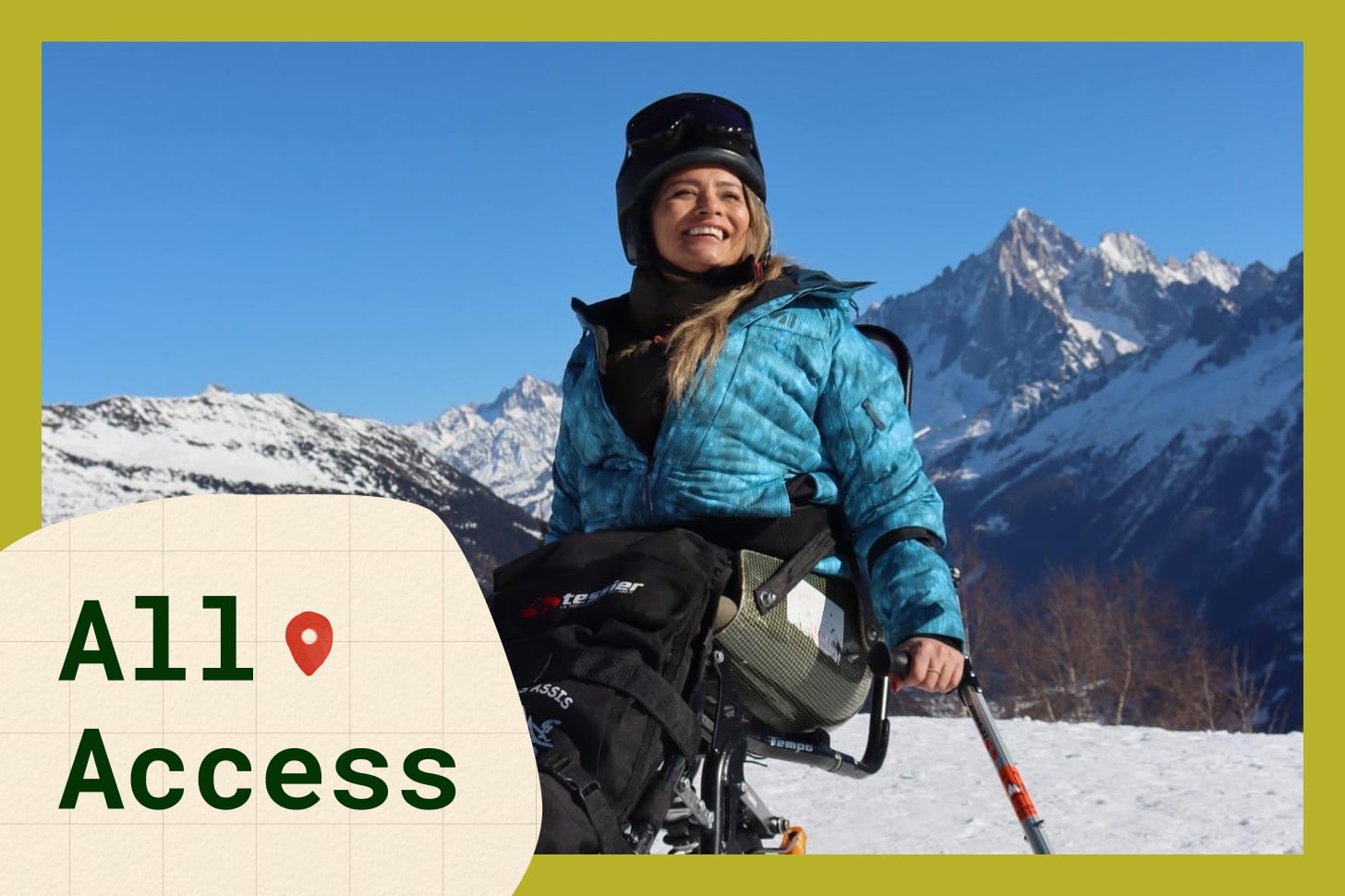
In our All Access issue, we're spotlighting how the disability community is making the outdoors more accessible for everyone. Explore the package here [1].
Marcela Marañon has always had an adventurous spirit. Before losing her leg and becoming paralyzed in a 2002 car accident, she enjoyed playing soccer and basketball and going for runs. After becoming disabled at 20 years old, she mainly focused on the essentials: her education, her job, and her children. It wasn't until a quadriplegic friend introduced her to adaptive sports that she realized there was a whole new world out there, just waiting to be explored.
It's undeniably harder to navigate an ableist world as a person with a disability, but Marañon is determined to show that not only is it possible — it's genuinely worth doing. Since the accident, she's become the first known wheelchair user to visit all Seven Wonders of the World. Ahead, she shares how she learned to overcome her fear, and why some things are worth doing scared — from visiting Machu Picchu to climbing the Great Wall of China.
After the accident, I made it a goal to visit the Seven Wonders of the World (the Colosseum in Italy, Petra in Jordan, Chichén Itzá in Mexico, Christ the Redeemer in Brazil, Machu Picchu in Peru, the Taj Mahal in India, and the Great Wall of China) — and in August, I became the first known wheelchair user to do it. This was a dream I'd had for a long, long time, but I didn't complete it sooner because I wasn't sure if all the wonders were truly accessible.
I remember visiting my first Wonder of the World — Machu Picchu — when I was only 16 years old. I was in awe of the beautiful, heightened city, which I easily navigated at the time. When I returned to Machu Picchu with a disability, I quickly realized the city was going to be very difficult for someone like me to visit.
For starters, the trains into the nearby town are not very wheelchair accessible. And after you arrive, you have to roll for 15 minutes to take the bus. After the bus, you have to travel another 45 minutes to get to the mountain. Once you get there, it's very challenging because there are no ramps at all, so you have to worry about your safety, you have to be careful not to fall. You have to trust strangers to carry your wheelchair to carry you. It's a totally different experience.
In February 2020, when I climbed Mount Kilimanjaro and became the first known disabled Latin woman to do so, I encountered similar struggles. It took me and the group I was with eight days to climb up to the top and back down to the bottom. As you hike, you go through different climates, and the peak is especially scary because it's so steep.
In fact, many people cannot go all the way to the top. In my case, I was sitting in a wheelchair with four or five people trying to bring me up the steep hill. I remember having a lot of fear — about the cold, about being carried up to the peak, about everything.
I am not being demanding when I say that every place needs to be accessible. Because I, as a disabled person, deserve to have equal access to public spaces, to the outdoors, without facing barriers that limit my participation. When places are accessible, it sends a message that everyone is valued and included, and that our right to enjoy the world is as important as anyone else's.
That said, during my journey to conquer the Seven Wonders of the World, I've had amazing, kind strangers that have wanted to help me. In these moments, it's not only my goal to get to where I'm going, but their goal as well.
You have to learn to trust strangers when solo traveling with a disability. I could just hire an inclusive travel agency that would do everything for me, but sometimes it's expensive, so I would rather just book my own flight, book handicap-accessible hotels, etc.
Of course, it can be scary, but I've never let fear stop me. I put a lot of time into seeing the Seven Wonders, not to mention all the stress I put my body through. At the end it was all worth it to feel that confidence, that empowerment, that feeling that you can do anything you want — even though your life, your body, has its limits.
And whenever the goal felt too big, it was my community that inspired me to push through. I wanted to send the message that if you are someone who lives with a disability and you dream of traveling the world but you're afraid, or you don't have anybody to travel with, you can still do it. You can still live that experience. You just need to show up and try. If you're not sure where to start, here are my top lessons and tips when it comes to traveling with a disability:
- Ask for help: I have been to so many places that are not wheelchair friendly, but I have managed to get help from the people around me. In Petra, I had strangers. In Chichén Itzá, I was also helped by strangers. I ask and I ask, and I don't get tired of asking until I find someone who wants to help me.
- Trust the people helping you: Overcoming the fear also requires a bit of trust. You have to trust in these tour operators or the people trained to take you to where you're going. Vet them before you go, of course. But then trust that these people want to help you with new travel experiences.
- Check if hotels are accessible: I do my own research on the hotel website to see if they're handicap accessible or not. Then I try them. The good thing is that I'm very independent with the way I move, so if I go to a hotel and it's not fully handicap accessible, I feel like I can manage that because I'm good with transfers and moving around. If you need more assistance, accessible travel agencies can also help.
- Be aware of older cities: Athens, for example, is a very old city, so they can't do a lot in terms of accessibility because everything is small and narrow. The doorways, for example, are so tiny. Plus, every country has different rules about accessibility — some people follow them, some don't.
- Extra devices can help: On my way to China, an exoskeleton technology company (wearable devices that provide mobility aid and support) reached out and said, "We would like you to host you, and we would like you to try our devices." If that didn't happen, I wouldn't have been able to do the Great Wall of China. I've also used an extra wheel device that I attach onto my wheelchair to help navigate the cobblestone streets of Istanbul.
- Accessible public transit: In Istanbul, I struggled to get around in my wheelchair because there were no curb cuts to navigate the streets. The best wheelchair-accessible transportation was the tram.
- Visit the tourist areas: That's not to say you can't go to the outskirts or lesser-known areas while abroad, but many tourist areas are wheelchair friendly because they're equipped to handle larger amounts of people. So when I went to Istanbul, which isn't very accessible, I went into tourist areas, different museums, Hagia Sophia (a famed mosque), and all of that.
Jump back to the All Access issue. [2]
— As told to Chandler Plante
Chandler Plante [3] is an assistant health and fitness editor for PS. She has over four years of professional journalism experience, previously working as an editorial assistant for People magazine and contributing to Ladygunn, Millie, and Bustle Digital Group. In her free time, she enjoys finding new ways to rock her 18(!) different eye patches and making videos about chronic illness, beauty, and disability.