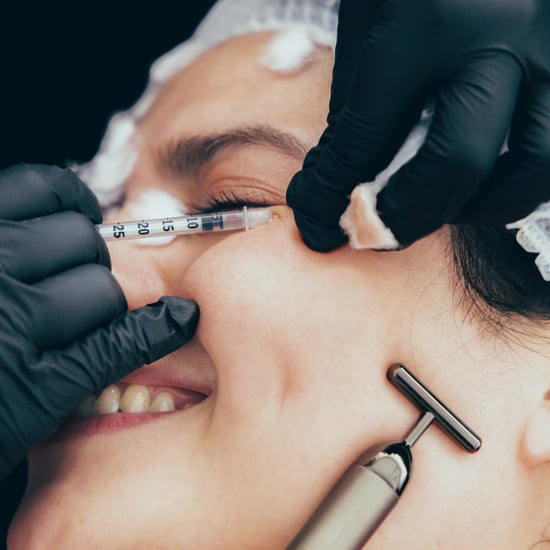
1. Hormones
Typically the first step in a transgender woman's process is hormone therapy. Aside from facial features, breasts are one of the first things that differentiate men and women. The estrogen and anti-androgen cocktail jump-starts breast development so that the areola are enlarged and the ducts begin to expand behind the nipple. The breast-growth process is similar to what might happen when a pubescent girl's mosquito bites develop into full-blown breasts. Between two months and two years, the area will expand to create a visible bosom. However, it's rare that the size will ever grow to anything over a B cup for a male undergoing the transition. Breast augmentation is a popular alternative.
You may have heard that birth control can clear up women's acne and improve skin tone, because the pill contains a high amount of estrogen and progesterone. Men transitioning to become women rely on hormones in a similar way. Guys naturally have thicker skin, larger pores, and an overall rougher complexion, and taking estrogen can counteract that.
In addition, men taking hormones will experience a decrease in body hair (on arms and legs). However, facial hair continues to grow. That's why many transgender women opt for more permanent hair removal solutions, such as laser or electrolysis.
After a year of taking hormones, those transitioning will find that fat gathers on different areas of the body, such as thighs, hips, and butt (re: the places us ladies usually want to lose weight). But this actually makes the body appear curvier — like a woman. As the waist slims down, the body takes on an hourglass shape. Upper-body muscle mass also decreases and genitals begin to shrink. All of these hormonal changes are subtle and can take up to two years to reach their peak.
2. Brow Lift and Forehead Recontouring
The last time you made a connection at a bar, we're guessing it was the simple come-hither stare and brow raise that initiated the first attraction. "The eyebrow area and the bone underneath is the most important area of our face," Dr. Spiegel explained. "It provides information such as are [you] a man or a woman, are [you] attractive, and are [you] familiar or not?" Humans (and other mammals) use the eyes and brow area to communicate without words. All of these things make the forehead area very important during FFS. Women typically have higher brows, whereas men have a more pronounced brow ridge (the bone just above the eyebrows). For a transgender woman, a brow lift raises the arches a few inches (similar to a face-lift), and a brow shave can minimize the prominence of the bone underneath arches. In more severe cases, patients can receive full forehead reconstruction in which the bone is removed, reshaped, and replaced.
3. Scalp Advancement
Men's natural hormones cause their hairlines to slowly recede with age, creating an M shape. You've probably noticed your father is thinning around the temples, while your mother just complains about overall hair loss. Estrogen hormones help halt male pattern baldness for transitioning transgender women. However, scalp advancement surgery can also counteract hair loss and give the hairline a U shape, which is more common among women.

![1. Hormones
Typically the first step in a transgender woman's process is hormone therapy. Aside from facial features, breasts are one of the first things that differentiate men and women. The estrogen and anti-androgen cocktail jump-starts breast development so that the areola are enlarged and the ducts begin to expand behind the nipple. The breast-growth process is similar to what might happen when a pubescent girl's mosquito bites develop into full-blown breasts. Between two months and two years, the area will expand to create a visible bosom. However, it's rare that the size will ever grow to anything over a B cup for a male undergoing the transition. Breast augmentation is a popular alternative.
You may have heard that birth control can clear up women's acne and improve skin tone, because the pill contains a high amount of estrogen and progesterone. Men transitioning to become women rely on hormones in a similar way. Guys naturally have thicker skin, larger pores, and an overall rougher complexion, and taking estrogen can counteract that.
In addition, men taking hormones will experience a decrease in body hair (on arms and legs). However, facial hair continues to grow. That's why many transgender women opt for more permanent hair removal solutions, such as laser or electrolysis.
After a year of taking hormones, those transitioning will find that fat gathers on different areas of the body, such as thighs, hips, and butt (re: the places us ladies usually want to lose weight). But this actually makes the body appear curvier — like a woman. As the waist slims down, the body takes on an hourglass shape. Upper-body muscle mass also decreases and genitals begin to shrink. All of these hormonal changes are subtle and can take up to two years to reach their peak.
2. Brow Lift and Forehead Recontouring
The last time you made a connection at a bar, we're guessing it was the simple come-hither stare and brow raise that initiated the first attraction. "The eyebrow area and the bone underneath is the most important area of our face," Dr. Spiegel explained. "It provides information such as are [you] a man or a woman, are [you] attractive, and are [you] familiar or not?" Humans (and other mammals) use the eyes and brow area to communicate without words. All of these things make the forehead area very important during FFS. Women typically have higher brows, whereas men have a more pronounced brow ridge (the bone just above the eyebrows). For a transgender woman, a brow lift raises the arches a few inches (similar to a face-lift), and a brow shave can minimize the prominence of the bone underneath arches. In more severe cases, patients can receive full forehead reconstruction in which the bone is removed, reshaped, and replaced.
3. Scalp Advancement
Men's natural hormones cause their hairlines to slowly recede with age, creating an M shape. You've probably noticed your father is thinning around the temples, while your mother just complains about overall hair loss. Estrogen hormones help halt male pattern baldness for transitioning transgender women. However, scalp advancement surgery can also counteract hair loss and give the hairline a U shape, which is more common among women.](https://media1.popsugar-assets.com/files/thumbor/6GvLzBCVtxWao0Mzy-HSRe_ed8A/fit-in/1024x1024/filters:format_auto-!!-:strip_icc-!!-/2015/04/30/716/n/1922153/7e9e567d64fbe2b2_2015_ba/i/1-HormonesTypically-first-step-transgender-woman.jpg "1. Hormones
Typically the first step in a transgender woman's process is hormone therapy. Aside from facial features, breasts are one of the first things that differentiate men and women. The estrogen and anti-androgen cocktail jump-starts breast development so that the areola are enlarged and the ducts begin to expand behind the nipple. The breast-growth process is similar to what might happen when a pubescent girl's mosquito bites develop into full-blown breasts. Between two months and two years, the area will expand to create a visible bosom. However, it's rare that the size will ever grow to anything over a B cup for a male undergoing the transition. Breast augmentation is a popular alternative.
You may have heard that birth control can clear up women's acne and improve skin tone, because the pill contains a high amount of estrogen and progesterone. Men transitioning to become women rely on hormones in a similar way. Guys naturally have thicker skin, larger pores, and an overall rougher complexion, and taking estrogen can counteract that.
In addition, men taking hormones will experience a decrease in body hair (on arms and legs). However, facial hair continues to grow. That's why many transgender women opt for more permanent hair removal solutions, such as laser or electrolysis.
After a year of taking hormones, those transitioning will find that fat gathers on different areas of the body, such as thighs, hips, and butt (re: the places us ladies usually want to lose weight). But this actually makes the body appear curvier — like a woman. As the waist slims down, the body takes on an hourglass shape. Upper-body muscle mass also decreases and genitals begin to shrink. All of these hormonal changes are subtle and can take up to two years to reach their peak.
2. Brow Lift and Forehead Recontouring
The last time you made a connection at a bar, we're guessing it was the simple come-hither stare and brow raise that initiated the first attraction. \"The eyebrow area and the bone underneath is the most important area of our face,\" Dr. Spiegel explained. \"It provides information such as are [you] a man or a woman, are [you] attractive, and are [you] familiar or not?\" Humans (and other mammals) use the eyes and brow area to communicate without words. All of these things make the forehead area very important during FFS. Women typically have higher brows, whereas men have a more pronounced brow ridge (the bone just above the eyebrows). For a transgender woman, a brow lift raises the arches a few inches (similar to a face-lift), and a brow shave can minimize the prominence of the bone underneath arches. In more severe cases, patients can receive full forehead reconstruction in which the bone is removed, reshaped, and replaced.
3. Scalp Advancement
Men's natural hormones cause their hairlines to slowly recede with age, creating an M shape. You've probably noticed your father is thinning around the temples, while your mother just complains about overall hair loss. Estrogen hormones help halt male pattern baldness for transitioning transgender women. However, scalp advancement surgery can also counteract hair loss and give the hairline a U shape, which is more common among women.")