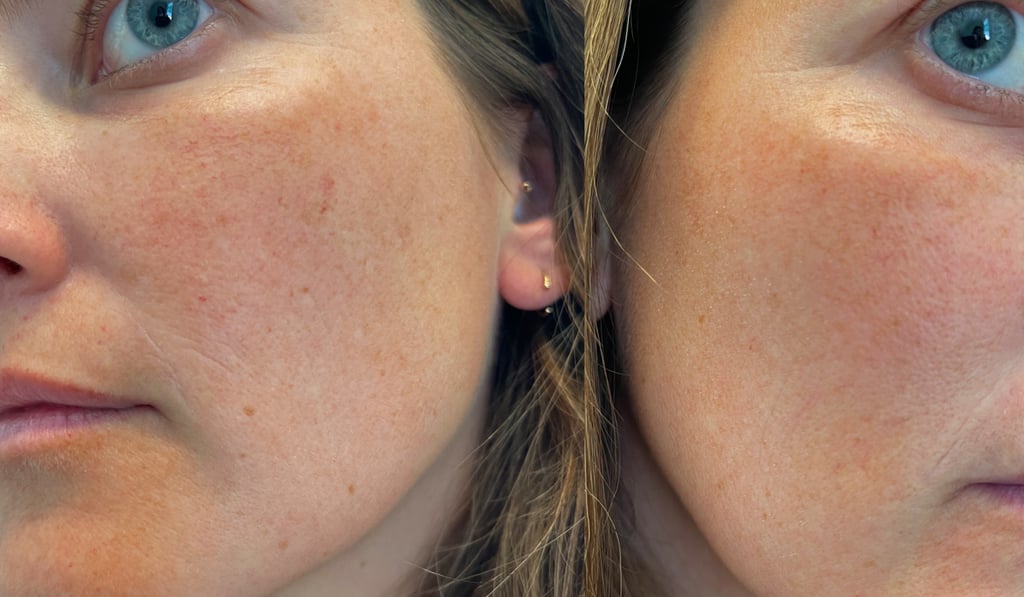
Here is a close up of what broken capillaries looked like on my skin before my treatment. Again, broken capillaries occur when the walls of the blood vessels beneath the surface of the skin are damaged and become dilated (aka enlarged). They can look like webbed spider veins, red splotches, or more enlarged singular veins. They usually pop up around your chin, cheeks, and nose — and I have a few dots around my lips.
What Is PDL?
Before diving in, let's quickly classify the two main types of lasers: ablative and non-ablative. "A fractionated ablative laser vaporizes small columns of skin from the exterior in, so all skin layers are effected," says Dr. Herrmann. "Non-ablative lasers and energy-based devices target deeper structures and spare the skin's surface." An ablative laser is the more "intense" of the two (think: Fraxel) and requires a lot more downtime in order to heal, as well as specific ointments.
PDL is a non-ablative laser.
So how does PDL work? "The laser light targets hemoglobin, a protein which is in red blood cells," Dr. Herrmann says. "It heats it up, and this heat collaterally damages the blood vessel walls surrounding it, which causes them to collapse and disappear. Because we have so many extra vessels in the skin, removing a few doesn't have any negative health consequence."