I Found My Breast Cancer, Thanks to Olivia Munn
She Discovered Her Own Breast Cancer While Reporting on Olivia Munn's Diagnosis

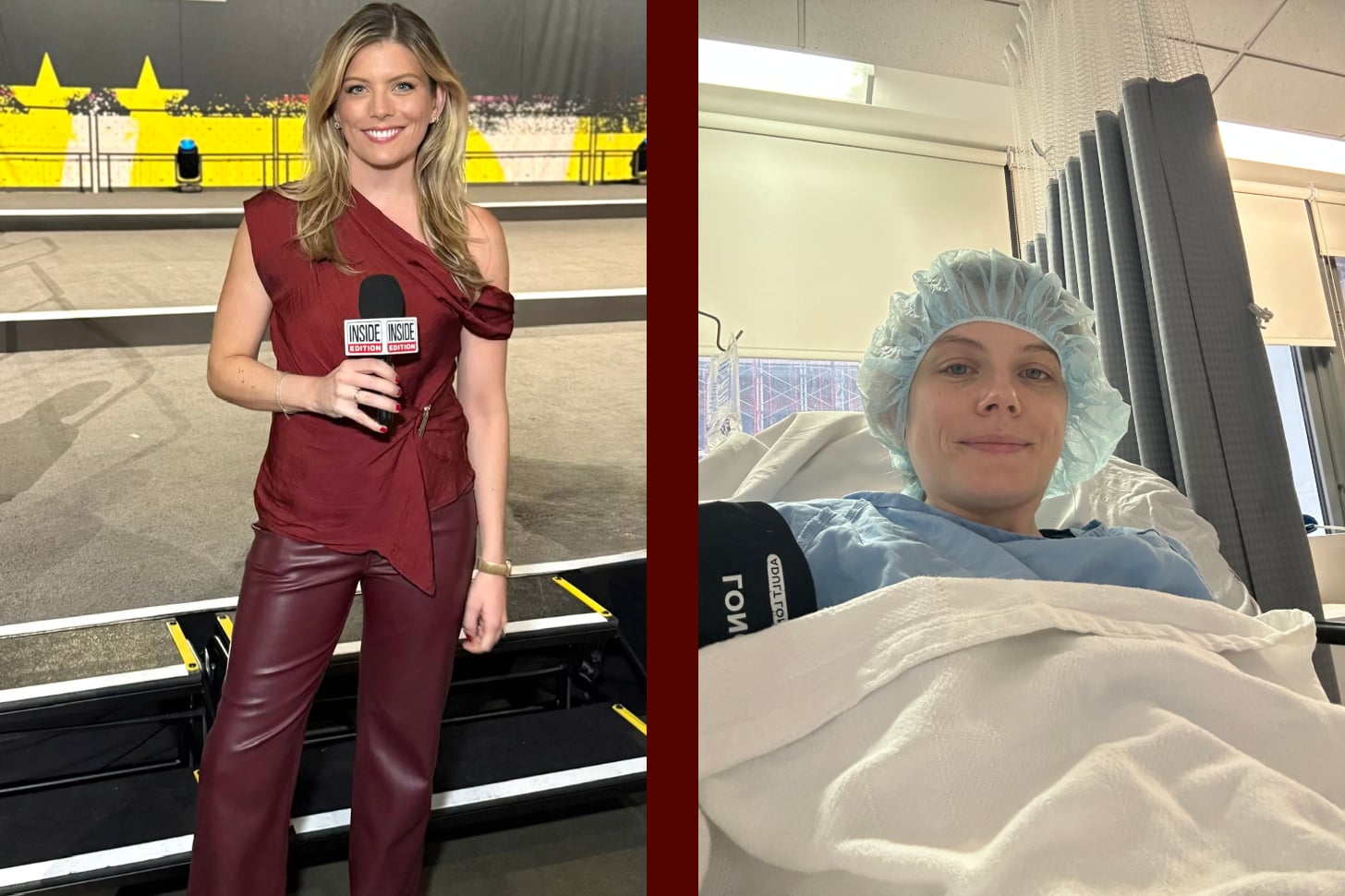
When Inside Edition reporter Alison Hall was assigned to report on actress Olivia Munn's breast cancer diagnosis in March of 2024, she thought it was just another day on the job. But when Hall learned about something called the breast cancer risk assessment via Munn, her life changed. Munn credited the breast cancer risk assessment score with saving her life, detailing her journey to early-stage diagnosis in a 2024 Instagram post. At the time, "I had never heard of this test. My boss had never heard of this test. It seems like most people had really never talked about it," Hall says. "So they wanted me to go interview a doctor." She went to Lenox Hill Hospital in New York and interviewed a surgical oncologist in the breast cancer department.
"I met [the doctor] for the first time, and my bosses had said, 'Alison, if you're comfortable with it, would you take the test on camera so that we can really show people what it's like?'" Hall agreed, noting how important it was to share this information. "I said, "Of course, I believe in breast cancer awareness. This is important to me and to everyone. I'm happy to do that." While filming the segment for Inside Edition, Hall answered the series of personal questions required for the breast cancer risk assessment on camera. And at the end of the test, the doctor told Hall that her results revealed a 36 percent chance of developing breast cancer at some point in her life. "Anything over 20 percent is considered high risk," Hall recalls being told.
"We just have a true bond now. It's a bond that I see replicated in so many women in the breast cancer space."
It was a shock to Hall, considering the preventative measures she'd already taken to mitigate her risk of developing the condition. Hall's mother is a breast cancer survivor; she was diagnosed when Hall was a teenager and is now healthy after undergoing treatment. "Breast cancer was definitely a big part of my life as a teenager, a big part of my family's life. And I wondered whether it would eventually become a part of my life more directly. So in my 20s, I sought out a test for the BRCA genes, and I tested negative," says Hall.
But in taking the risk assessment that day, Hall became less confident about her future health outcomes. "I remember seeing Olivia's story earlier that day, and she noted that she was 37 percent," Hall recalls. Her score was just one point below Munn's. "So that raised my alarm bells a little bit," Hall says. After the test was over and the cameras were off, the doctor Hall interviewed urged her to take the test results seriously and get further screening.
Hall did, eventually getting a mammogram that revealed that she had dense and cystic breasts. She was told to get an MRI for more analysis since her breasts were considered extremely dense, which can make it harder to spot breast cancer. Hall scheduled the MRI for October 2024 and was notified that a few spots needed biopsy. The biopsies then revealed that she had early-stage breast cancer.
"As soon as I was diagnosed, I thought about [Olivia Munn] and just how wild this story was and how so many things needed to come together in order for me to get this early-stage diagnosis," Hall says. She was flooded with a mix of emotions, from devastation to gratitude. So she channeled that into an email and sent it to Munn who responded and continued to check in on her amidst her treatment process. "She was just so incredibly sweet and generous," Hall says. Eventually the two met in person and Hall was able to thank her IRL for her role in her early diagnosis. "We just have a true bond now. It's a bond that I see replicated in so many women in the breast cancer space; it really is a special connection," Hall says.
A few weeks after being diagnosed, Hall decided to get a double mastectomy with reconstruction (she was diagnosed in October 2024, and scheduled the surgery for January 2025) an experience that she says some people have misconceptions about, likening the procedure to an elective breast augmentation. "I feel passionately about educating people that a double mastectomy with reconstruction is very far from breast augmentation. It's a much more in-depth and strenuous surgery. It takes a lot out of your body, and it changes your body and your nerves and the functionality of your breasts for the rest of your life," Hall says. The surgery was challenging for her not only physically, but emotionally, an aspect of the recovery process that no one really talks about.
"To have something that was going to change my body – and a disease that is really scary that was threatening my body – it sort of created this feeling of feeling unsafe in my body," Hall says. "I really had to work hard to sort of build back that sense of safety and that sense of love for my body, knowing what it looks like and feels like now is different than what it was before." Now a year out from her second surgery (commonly referred to as "exchange surgery," where temporary breast implants called "expanders" are removed and replaced with more long-term silicone implants), Hall says she's regained her sense of confidence.
"[I'm] feeling better in my body and with my breasts than I ever thought that I would," she says. Her advice for others: It does get better — and to be patient when it comes to judging yourself and the experience. It can time to get to a place of acceptance, Hall admits, noting that it's been an active practice of self-love. "It's patience combined with actively working on it," she says.
Mercey Livingston is a writer and editor with eight-plus years of experience covering fitness, health, and nutrition for media outlets and brands including Well+Good, Shape, and Women's Health. She was the fitness editor at Peloton and held editorial roles at Equinox, Shape, and Well+Good. Mercey is a NASM-certified personal trainer and women's fitness specialist. She's also a certified holistic health coach through the Institute For Integrative Nutrition, with an additional certification in hormone health. She has a BA in journalism from the University of Southern Mississippi.