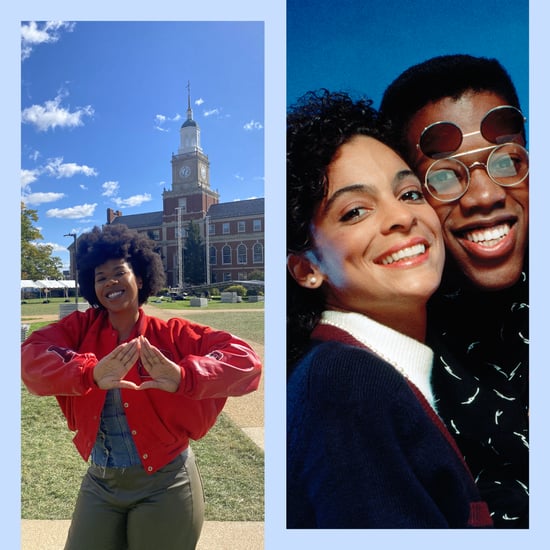
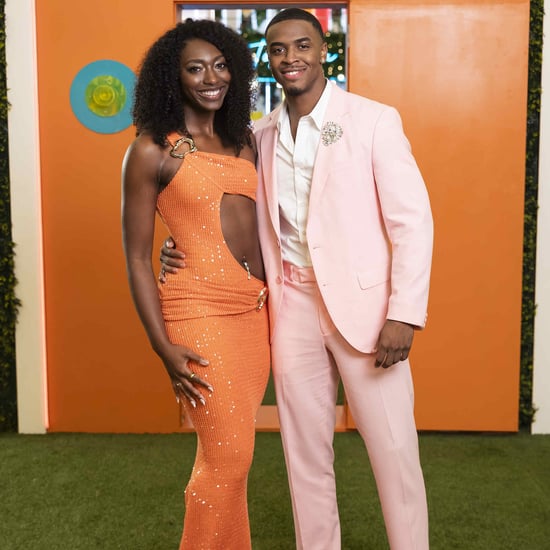
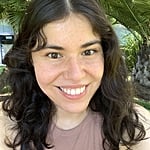
Through her own filmmaking, the "Bell Parks" creator wants to inspire other artists to speak out about issues that are close to them, thereby generating greater onscreen representation for communities that are often overlooked. "I think we're seeing changes in Hollywood [but] we're certainly in need of more changes, not only in terms of Black representation but representation of all people of color, people in the LGBTQ+ community, immigrants, the list goes on," she said. "And I want people to know that Hollywood is definitely a very large propeller of change, but it can't end there. It also takes people doing a lot of the groundwork, and you don't need to be an artist to help activate change. It's something that we all need to do as a practice locally as well as globally."
"Listen, Beyoncé is amazing. I love her as much as the next person, but that's not going to solve the school-to-prison pipeline. That's not going to solve police brutality."
As the film industry continues to progress, Gabrielle hopes to see issues of social injustice become more prevalent on screen to shine a light on minority groups that do not see themselves represented in films. "I'm a Black woman speaking my truth, and of course, inequality and social injustice is a large part," she said. "I just hope that my filmmaking will implore people to always consider whatever story isn't being told," Gabrielle added, citing that Black trans women, in particular, have endured numerous hate crimes, which are rarely, if ever, presented in the media. "I'd like to see more visibility given to that and to these communities within the larger community because we do have a tendency to speak more about the cis, straight male narratives and I think it's really important to include everyone in the conversation and make sure that we're constantly assessing the lens through which we're looking at social injustice."
Beyond representation, Gabrielle says people must not simply be satisfied with the work that's already been done, but continue to push for change every step of the way, both on screen and off. "It goes past representation," she said. "I was actually talking to someone the other day and she said, 'Oh, how could you have felt so insecure as a child when you have Beyoncé?' It's like, 'Listen, Beyoncé is amazing. I love her as much as the next person, but that's not going to solve the school-to-prison pipeline. That's not going to solve police brutality.' It takes so much more than that."
![Through her own filmmaking, the "Bell Parks" creator wants to inspire other artists to speak out about issues that are close to them, thereby generating greater onscreen representation for communities that are often overlooked. "I think we're seeing changes in Hollywood [but] we're certainly in need of more changes, not only in terms of Black representation but representation of all people of color, people in the LGBTQ+ community, immigrants, the list goes on," she said. "And I want people to know that Hollywood is definitely a very large propeller of change, but it can't end there. It also takes people doing a lot of the groundwork, and you don't need to be an artist to help activate change. It's something that we all need to do as a practice locally as well as globally."
"Listen, Beyoncé is amazing. I love her as much as the next person, but that's not going to solve the school-to-prison pipeline. That's not going to solve police brutality."
As the film industry continues to progress, Gabrielle hopes to see issues of social injustice become more prevalent on screen to shine a light on minority groups that do not see themselves represented in films. "I'm a Black woman speaking my truth, and of course, inequality and social injustice is a large part," she said. "I just hope that my filmmaking will implore people to always consider whatever story isn't being told," Gabrielle added, citing that Black trans women, in particular, have endured numerous hate crimes, which are rarely, if ever, presented in the media. "I'd like to see more visibility given to that and to these communities within the larger community because we do have a tendency to speak more about the cis, straight male narratives and I think it's really important to include everyone in the conversation and make sure that we're constantly assessing the lens through which we're looking at social injustice."
Beyond representation, Gabrielle says people must not simply be satisfied with the work that's already been done, but continue to push for change every step of the way, both on screen and off. "It goes past representation," she said. "I was actually talking to someone the other day and she said, 'Oh, how could you have felt so insecure as a child when you have Beyoncé?' It's like, 'Listen, Beyoncé is amazing. I love her as much as the next person, but that's not going to solve the school-to-prison pipeline. That's not going to solve police brutality.' It takes so much more than that."](https://media1.popsugar-assets.com/files/thumbor/WxNAeKOuazsMqG2caxKW5NpGPYM/fit-in/1024x1024/filters:format_auto-!!-:strip_icc-!!-/2021/03/01/034/n/1922398/4ed344812396edfa_gab4/i/Through-her-own-filmmaking-Bell-Parks-creator-wants-to-inspire.jpg "Through her own filmmaking, the \"Bell Parks\" creator wants to inspire other artists to speak out about issues that are close to them, thereby generating greater onscreen representation for communities that are often overlooked. \"I think we're seeing changes in Hollywood [but] we're certainly in need of more changes, not only in terms of Black representation but representation of all people of color, people in the LGBTQ+ community, immigrants, the list goes on,\" she said. \"And I want people to know that Hollywood is definitely a very large propeller of change, but it can't end there. It also takes people doing a lot of the groundwork, and you don't need to be an artist to help activate change. It's something that we all need to do as a practice locally as well as globally.\"
\"Listen, Beyoncé is amazing. I love her as much as the next person, but that's not going to solve the school-to-prison pipeline. That's not going to solve police brutality.\"
As the film industry continues to progress, Gabrielle hopes to see issues of social injustice become more prevalent on screen to shine a light on minority groups that do not see themselves represented in films. \"I'm a Black woman speaking my truth, and of course, inequality and social injustice is a large part,\" she said. \"I just hope that my filmmaking will implore people to always consider whatever story isn't being told,\" Gabrielle added, citing that Black trans women, in particular, have endured numerous hate crimes, which are rarely, if ever, presented in the media. \"I'd like to see more visibility given to that and to these communities within the larger community because we do have a tendency to speak more about the cis, straight male narratives and I think it's really important to include everyone in the conversation and make sure that we're constantly assessing the lens through which we're looking at social injustice.\"
Beyond representation, Gabrielle says people must not simply be satisfied with the work that's already been done, but continue to push for change every step of the way, both on screen and off. \"It goes past representation,\" she said. \"I was actually talking to someone the other day and she said, 'Oh, how could you have felt so insecure as a child when you have Beyoncé?' It's like, 'Listen, Beyoncé is amazing. I love her as much as the next person, but that's not going to solve the school-to-prison pipeline. That's not going to solve police brutality.' It takes so much more than that.\"")