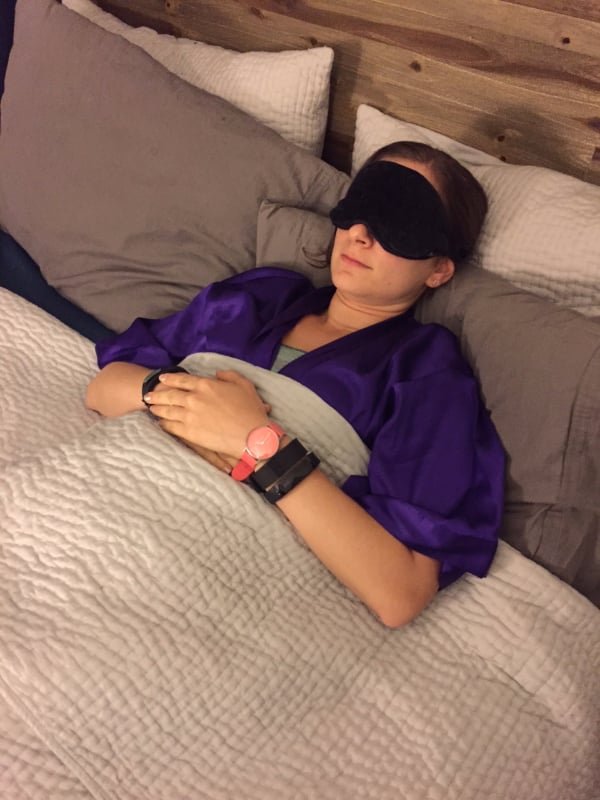
You didn’t think I stopped with the steps and distance, did you? Nope. I also wore these babies to bed (or at least the ones that promised sleep tracking, anyway).
The Misfit, Fitbit, and Jawbone all are supposed to track your sleep automatically (meaning you don’t have to push any buttons to put the device in “sleep mode”). They said I slept between nine hours, 14 minutes and nine hours, 49 minutes (sometimes I like to bank shuteye on Sunday nights, okay…?). They also said I woke up between zero and two times during the night. But since I can’t say for sure exactly when I fell asleep or how restful or restless my night was...there’s no way to know which device was the most accurate on this front. (Sorry, guys!)
The Pivotal Living band has a sleep-tracking mode that you can activate by double-clicking the button on it until you see a moon icon on the screen. But even though I did this, the band didn't seem to record my Zs; I didn’t see any relevant data on the app after I synced my tracker the next morning.
I also performed one other test: counting my actual heart rate and then using the devices that measure it to see how close they got. I’m happy to report that all of the trackers do a great job on this: The Fitbit was dead-on, the Apple Watch gave a reading 1.89 percent above my actual heart rate, and the Android 360 came in 9.43 percent above it (although my heart rate was 53, so a reading of 58 isn’t so far off).
You may have noticed that the Jawbone has heart-rate functionality but that I didn’t include it in this test. That’s because you can’t check your heart rate on demand with this device — but it’s constantly monitoring you to provide data on your resting and active heart rate. The app also provides lots of guidance on what all of the numbers mean, which is a definite plus (while the 10,000 step benchmark is easy enough to grasp, the other numbers can be tough to glean meaning from).