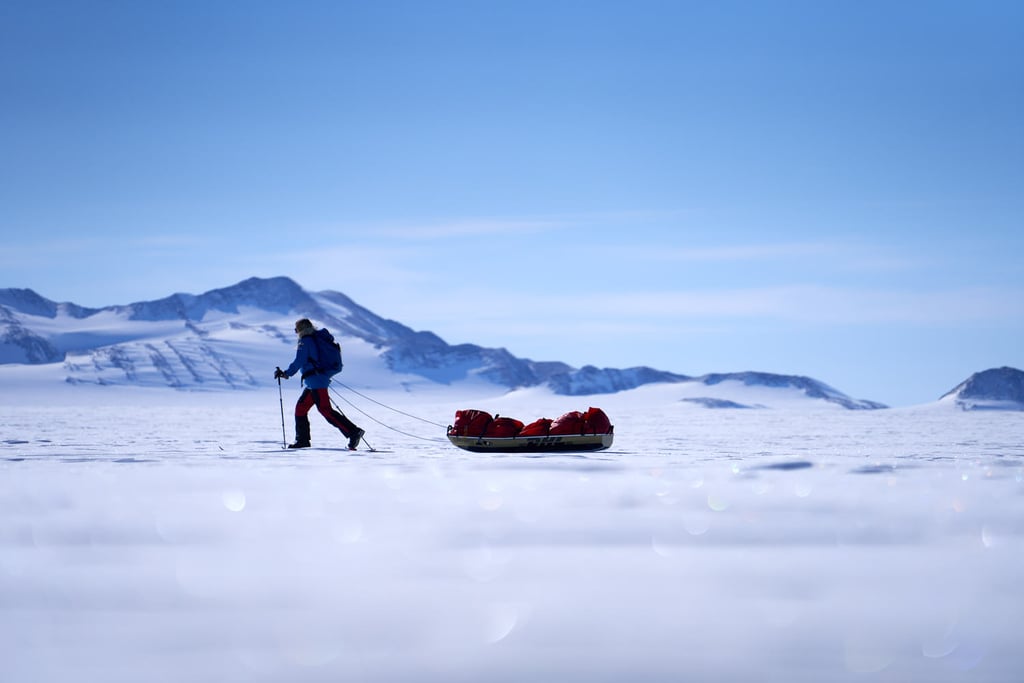
There's a key caveat to the Antarctica speed record: it has to be done unsupported and unassisted. That means no outside help, no plane delivering more food or supplies, no truck or motorbike or means of transportation that isn't human-powered. Jenny had to be in good enough shape to ski the entire distance, 12 to 14 hours a day for 38 days. And she had to get strong enough to do it while dragging a 180-pound sled of food and supplies, uphill and into the wind the whole way.
Jenny's first attempt required two years of preparation, and recovering from it took several months. Once Summer 2019 rolled around, it was full throttle on the training for attempt number two. Her mind-boggling training regimen requires six workouts a week: three weightlifting sessions and three long conditioning workouts, walking for seven or eight hours on a treadmill set to maximum incline. To mimic the drag of the sled, she straps herself into a bungee cord harness and attaches it to a 220-pound weight behind her. To acclimate to Antarctica's high elevation, much of her training is done in a high-altitude gym; now, just weeks away from her second attempt, she's even sleeping in a high-altitude tent. Between the physical training and the mental (visualization and meditation), Jenny said, "you basically need to bulletproof your body as much as you can."
For fuel, Jenny (amazingly) has used the low-carb Atkins diet for years. "I'm a low-carb athlete," she said. "That's how I perform much better." For what she does, it makes sense. Jenny estimated that she burns about 10,000 calories a day in Antarctica, but she's limited to packing about half of that. Whatever she brings has to be as fuel-efficient as possible, and fat and protein are more calorie-dense than carbs.