An Immigrant's Message to Donald Trump
"Why My Voice Still Matters in This Election Even Though I Can’t Vote"

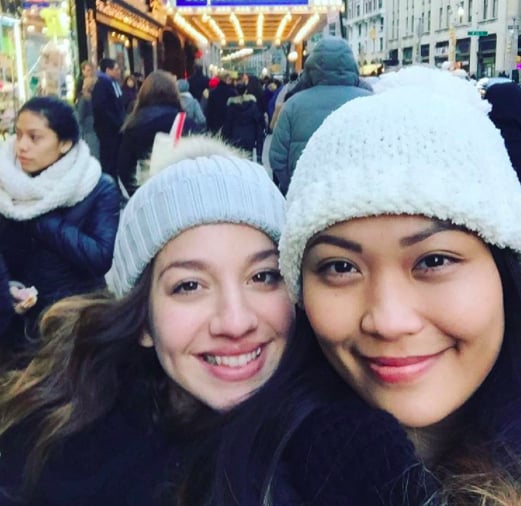
Myself (left) and Annie Zhou (right) in New York City.
Donald Trump probably wouldn't want many of his supporters to actually meet my friend Annie Zhou. That's because she represents a side of the immigration story that doesn't fit into his divisive narrative.
The Annie I know isn't some hostile foreigner Americans need to fear. She is now a third-year student at New York University School of Law, but seven years ago, she was just an 18-year-old girl armed with ambition and a student visa who left her home country of Jamaica because she "always wanted to learn and experience life in a big city." Upon graduating from the University of Rochester in 2014 with a degree in economics and business, Annie decided there was more for her to accomplish in this country and she chose to pursue her graduate education in the US.
Equally obsessed with Kanye West and Ruth Bader Ginsburg, she has fully adopted American culture. But one of the most important things you should know about her is that at just 25 years old, she is so close to fulfilling her goal of practicing law in New York — if only the government will allow it.
Learning about the arduous process Annie faces to stay in the US has left me horrified at the idea of practices like "extreme vetting" that require harsher screenings and question the personal beliefs of anyone trying to enter the country, practices that the Trump campaign has continued to push all with the aim of stifling legal immigration and painting prospective Americans like Annie in terrifyingly broad, inaccurate strokes.
Lately, I've wondered if the way we speak about immigrants in this country might drastically shift if every American had the opportunity to connect with just one person in Annie's shoes. I've wondered why we feel the need to protect ourselves against people aiming to stay in this country to contribute to its success. And while I unfortunately can't hand deliver Annie to each American voter before heading to the polls, I can put one of our many conversations about immigration issues down on the record. Ahead, check out my interview with her on what Trump gets wrong about immigrants and the real difficulties she faces to stay in this country.
On the hurdles she faces to stay in the US
"Once I graduate, my student visa only gives me a one-year window to work in this country. Then the law firm that hires me has to apply for me to change my status to a H1B visa, which is considered a visa for professionals. The process for getting that probably isn't what you'd expect.
"It's really just a completely randomized lottery — last year only about 36 percent of [qualified] applicants received the visa. It's crazy to think that I've spent four years in undergrad, earned a graduate degree, secured a job from an amazing company, all inside the US, and then will be faced with a roughly 65 percent chance of being told to get out of the country. The odds are really scary."
On what Trump doesn't understand about our immigration system
"Immigration issues are nuanced and complex on every level, and it's so dangerous to reduce these problems to three little words like 'build a wall.' This is a human issue. Immigrants have families, stories, and hardships that aren't always talked about.
"But I really want to address one of the most common arguments from Trump's camp, particularly an interview that Melania Trump gave a few months ago. The general gist of her argument was that she did it legally, so why can't all these undocumented immigrants just follow the law like her? And that is where the nuances and complexity of immigration issues come into play. [Editor's note: The Associated Press recently unearthed documents that show Melania Trump worked illegally in the country when she first arrived in the US.]
"The system is so broken for both legal and undocumented immigrants. Educated, legal immigrants who can perform highly skilled jobs in top companies (like me) are more likely to not get their visas than to get valid work authorization. It's all about luck. What do you say to those unlucky people then? They follow the law, their skills and contributions are valued at tech companies, law firms, banks, and science labs — but it still doesn't work out. When Melania applied in 1996, the landscape of the world was completely different. The visa lottery that I spoke about earlier had the same exact cap in 1996 but way less applicants. By marrying someone as wealthy as Trump, she also had access to some as best immigration attorneys that not everyone can afford."
"You have the unique power to inform people about these really complex issues. Don't waste it."
On making her voice heard without a vote
"I joke all the time that I'm part of the taxation-without-representation group, especially since I feel like I've been in the United States long enough now to feel invested in the well-being of the country. And it definitely does feel a bit disheartening that I can't vote. But I've pestered all my friends who can vote to go do it. I'm even proud to say I've actually convinced some of my friends who have never voted before to register and vote.
"But if you're like me and you can't vote, keep talking to your friends, your peers, your work colleagues — anyone who will listen — about the immigration issues that are complicated and not well known. You have the unique power to inform people about these really complex issues. Don't waste it."