As an athlete and a trainer, I know that recovery is just as important as the work you put in when you're training. If you aren't well rested, running a half-marathon or trying to go for a PR when lifting weights is going to be tough. Recovery is also important for cognitive function, improved mood, physical performance, and to prevent injury.
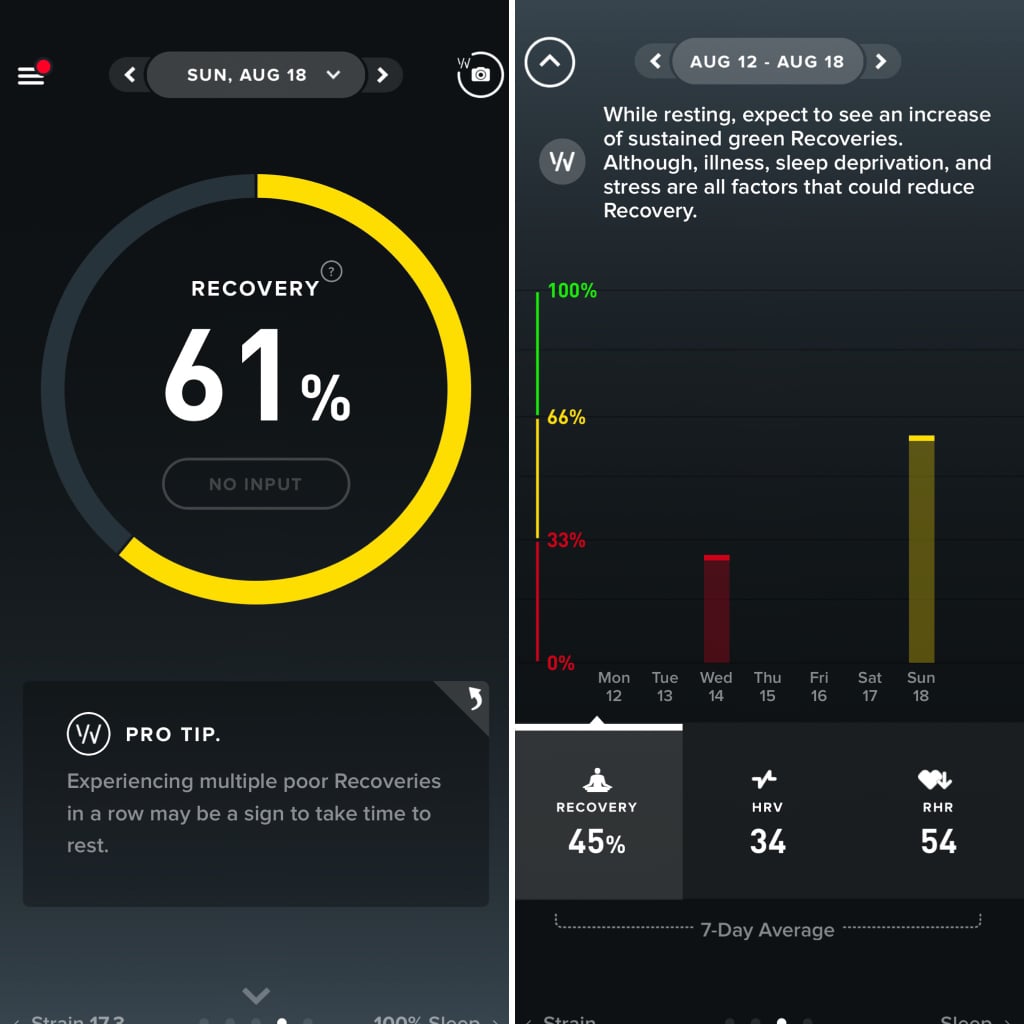
Your recovery is calculated on three physiological markers: your heart rate variability (HRV), resting heart rate (RHR), and the amount and quality of sleep you get. Stress, sickness, and fatigue impact your recovery as well. According to the Whoop site, your HRV is the variation in time between each heart beat and can help determine the level of intensity you should be training at. Your RHR is measured during your sleep. A lower RHR is an indicator of improved fitness and recovery.
When your recovery is high — this appears as a green bar — your body is ready to take on strain, and when it's low — this will be a yellow or red BAR — it's a sign you're at risk of injury or overtraining.
Why I like the recovery tool: I'm very in tune with my body and how I'm feeling, and the recovery tool provides me with more insight on how hard I should push my body. It also helps me be realistic about how I should train on any given day. I know if my recovery is in the red, it's probably not the best idea to try and run 10 miles. On days where my recovery is poor, I'll skip the strenuous workout and opt for something lighter such as mobility work.