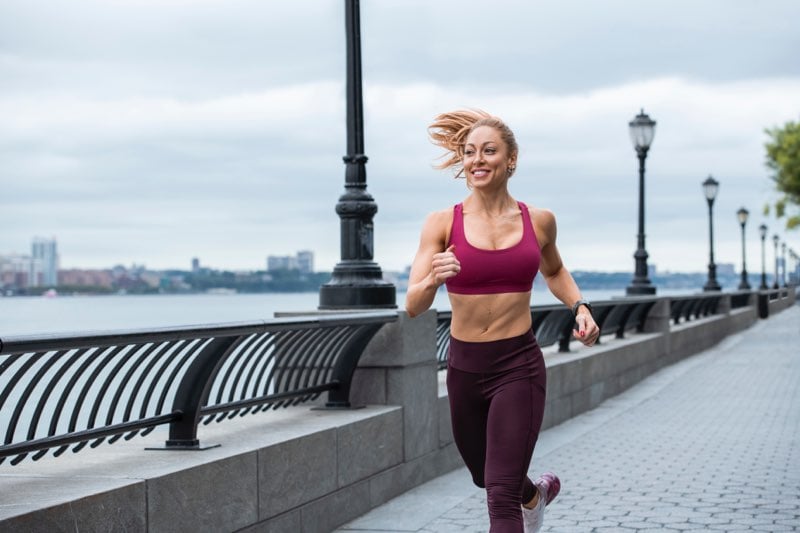
Pictured above: Peloton instructor Jess King out on a run.
PS: Is there a difference in overstriding on a treadmill versus overstriding outside?
BG: I tell a runner on a tread to settle far back enough from the crossbar so that knee knocks are avoided. This will also help you determine that the speed is within your comfort zone, otherwise the human mechanics switch to relying on the tread belt to pull the leg back behind the runner rather than using muscular strength.
JK: When I was training to become a tread instructor, I had to correct my overstride. I did this by slowing down the speed on my treadmill and taking lots of tiny, fast steps. The focus was on keeping my feet right underneath my hips and almost double-timing my steps.
PS: What other workouts or exercises can help prevent an overstride?
BG: Warming up and activating your whole body before a run is imperative for efficient performance, so a Peloton Warmup class is my go-to. Overstriders should focus on activating the glutes before a run. If you have mini bands, place one around your legs just about your knees, stand in a 70 percent squat position, and perform moves here including lateral steps and forward and backward steps. Taking a Peloton Strength for Runners class a couple times a week will also encourage that muscular-skeletal relationship to grow while working on your balance.
JK: I have spent the majority of my running training focusing on drills; marching, skipping, A-runs, shorter sprint efforts, as well as strength training with specificity for running. Peloton instructor Andy Speer is my personal trainer and so much of what he does with me, he also teaches in his Peloton Strength classes. Download the Peloton Digital app and keep us in your back pocket. Our programming includes pre-run warmups, warmup runs, and strength for runners; all designed to keep you training smart and strong.
PS: How much do running shoes matter when it comes to an overstride?
BG: To be honest, a sneaker is not going to fix this issue; it is certainly something that needs to be solved through practice and patience. Your body takes time to adapt to any change, so choosing to focus time and energy into creating your most efficient running form is your first port of call, just make sure you are in a running shoe!
JK: Personally, I think sneakers are a matter of preference. I look for something lightweight, supportive, with enough width for my foot to expand, and in a fun, bright color.