Why Do I Feel Depressed After Running a Marathon?
Why You Might Be Feeling Bummed Instead of on Top of the World After Running a Marathon

That’s Why They Call It the Postmarathon Blues
Now what? It's a question that can be loaded with possibility, excitement, and hope . . . or sadness, anxiety, and existential dread. After reshaping our lives around meeting an epic goal, whether it's climbing a mountain, losing a significant amount of weight, or completing a marathon, many of us find ourselves at a loss.
"I thought my post-race emotions would be a glow of endorphins . . . and they were closer to a bad breakup."
While the postmarathon blues, also commonly referred to as post-race letdown, might not be a clinical diagnosis, it is a widely recognized phenomenon among athletes, coaches, and sports psychologists. The perceived crash is due to a combination of physiological factors and can take the form of behavioral, cognitive, and emotional symptoms. This kind of after-achievement struggle can be especially pronounced for professional athletes who shape their entire lives — and, often, their identity and self-worth — around succeeding in their sport. Michael Phelps and Lindsey Vonn are just two Olympians who are helping shatter the stigma around this experience, which is both taboo and common enough that it has its own moniker among athletes in the Games: "five-ring fever." Still, a similar sense of feeling unmoored, lost, physically depleted, and even depressed can be felt among us "regular" folks who chase big athletic dreams.
Take me, for example. From June to October of this year, I trained — hard — with my teammates. During the peak of our training schedule, I was spending up to 10 hours a week sweating it out. That's not counting all the related commuting, socializing, prep, and recovery time. (And the laundry. Oh, god, there was so much laundry.)

I was lucky to have world-class coaches and a built-in support system of fellow athletes who were experiencing the same triumphs and challenges as I was. We were a group of runners from all walks of life, from our early 20s to our late 30s. Most of us had never before run a marathon, though in addition to our world-class running coaches, Bec Wilcok and Blue Benadum, we had a group of five mentors who had.
In talking with my teammates post-race, I discovered that, no matter what our fitness levels, experiences, or lifestyles were like before we started training, most of us faced some difficulty in the wake of the marathon. Not only were we forced to take some time off of running (which is recommended even if you're not injured) and physically depleted, but emotionally, many of us were also conflicted. One of my teammates described feeling "underwhelmed" by the race itself after the immense buildup to the big day, while another said she felt abandoned and "alone" after saying goodbye to our team workout schedule.
"I thought my post-race emotions would be a glow of endorphins . . . and they were closer to a bad breakup," my teammate Maile Minardi, a 20-year-old student and marketing professional, quipped.
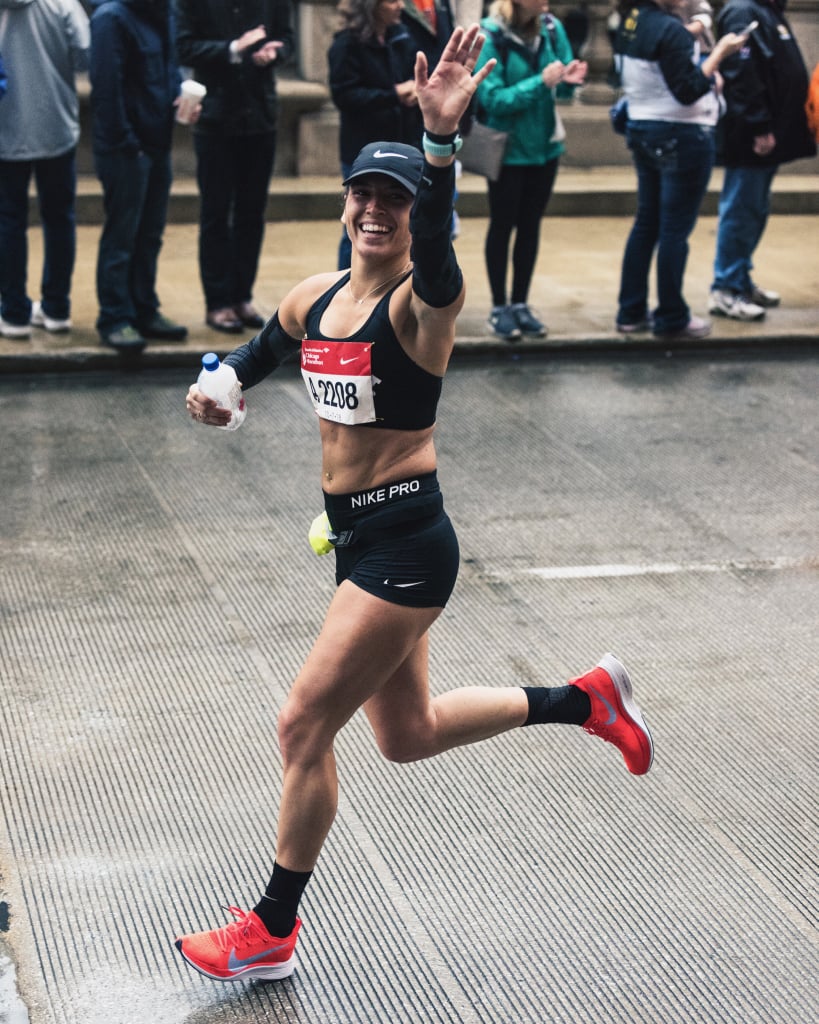
Our mentor Jenna Crawford (pictured above) is a 28-year-old marketing coordinator who has run 11 marathons. (And trust me: she's fast.) In Chicago, she beat her personal record by a full nine minutes but still found herself struggling emotionally despite her success.
"After the highs of celebrating my PR and smiling endlessly as friends, acquaintances, and strangers who sent their congratulations, I realized I felt very overwhelmed when I should have felt happy," Crawford told me a few weeks after the race. "I had reached one of my goals with this marathon PR, but I realized that I had literally invested my life into training, which came at the sacrifice [of] other roles I had in my life."
Another Nike Women Marathon Project runner, 21-year-old student Andrea Escobar, said she's experienced a similar crash after each of the two marathons she's run. "Coping with the aftermath of recovering and trying to relax after weeks of training has been extremely difficult. I tend to feel empty because I'm not training intensively."
Even the professional athlete in our midst could relate. Amberley Shaw, a 34-year-old professional boxer, said the abrupt ending to our long marathon journey hit her hard, "mostly because it was such a change to be a part of a team, and then all of a sudden, bang, we are done," she explained. "I felt alone — almost like it was just a dream that happened. I'm an extremely passionate person and do everything at 1,000 percent, so it's hard for me, emotionally, to deal with sudden change and endings."